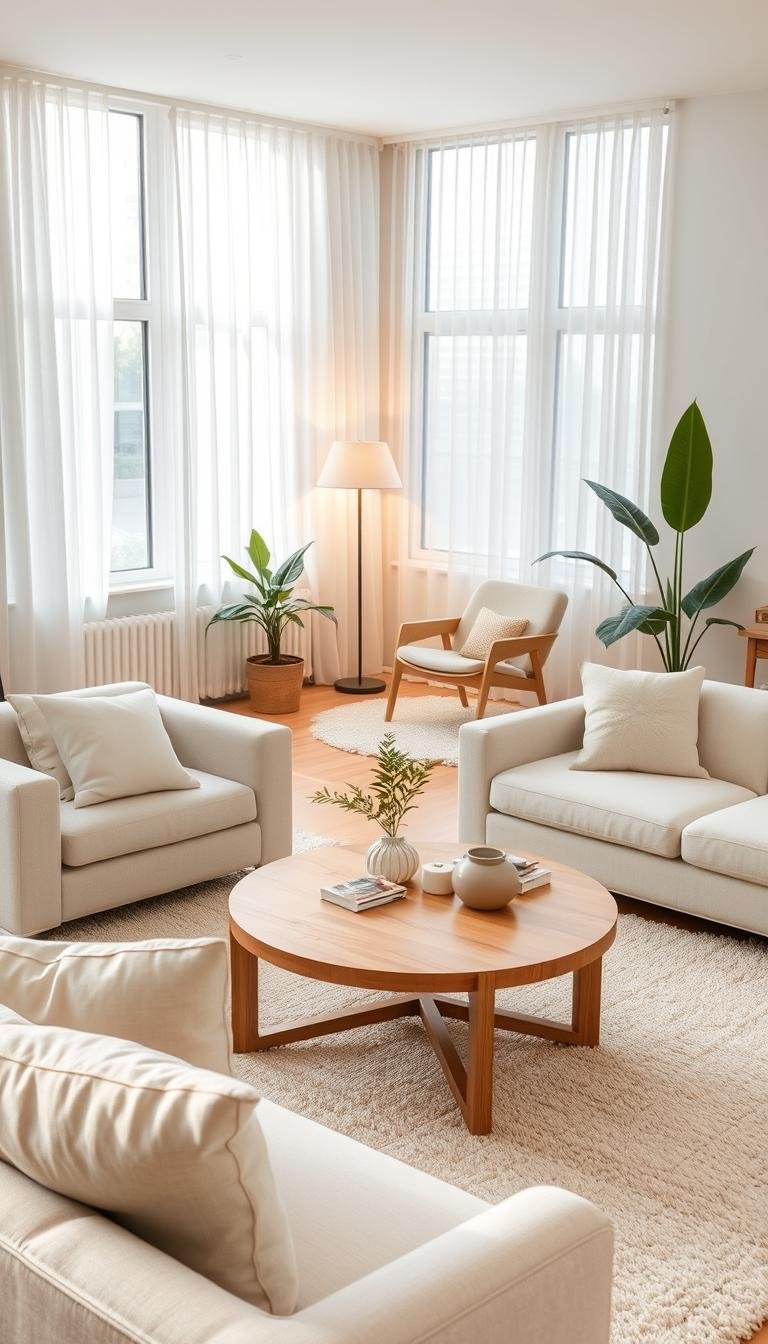
A serene room does not need to be bare; it needs a few thoughtful choices that make everyday life feel easier, the heart of Scandinavian living room inspiration. When your home feels crowded or too carefully arranged, natural light, useful furniture, and tactile materials can make everyday space more comfortable. Hygge is the Danish idea of warmth, wellbeing, and coziness.
You do not need a large home or a fresh set of furniture to make a room feel calm. Small changes can help what you already own feel more intentional, while making room for comfort and daily routines. You will find practical inspiration for different room sizes and existing furniture, so you can shape a lived-in space rather than stage a showroom.
Begin with the room you have, keeping what serves you and making space for what brings you comfort.
Scandinavian Living Room Inspiration Starts With a Warm, Light Palette
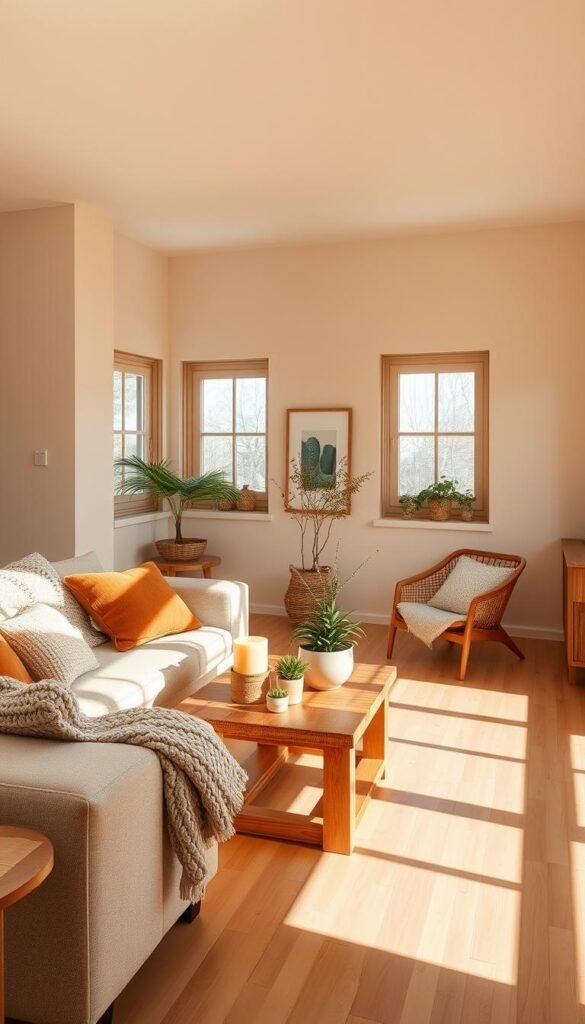
Creamy white and oatmeal give you a brighter backdrop without the sharp feel of stark white. A warm Scandinavian living room pairs pale walls with earthy details, so the room feels welcoming instead of cold. Warm Scandinavian design relies on more than white walls: natural materials and grounded accents give pale colors their softness.
Scandinavian style is commonly linked to Denmark, Norway, and Sweden, while warm neutrals and natural materials connect it to broader Nordic influences. Scandinavian interior design balances light, restraint, and natural influence; you can keep that balance without stripping away every personal detail.
Keep the backdrop light, then use earthy accents to stop pale colors from feeling cold.
Choose warm neutrals instead of stark white
Creamy white, oatmeal, sand, warm gray, and taupe keep walls bright without feeling severe. White walls can still work, especially when nearby natural materials add softness. A little variation between the wall, trim, and textiles gives the eye something to settle on.
Warm shades are a helpful starting point when you want Scandinavian style but prefer a lived-in feel. A study of 443 students found that interior color measurably shaped how satisfied and calm they felt at home. The finding is a reminder that a palette can affect how a room feels, not just how it photographs.
Use accent colors to keep the palette grounded
Add small touches of charcoal or black for contrast, then bring in restrained sage, dusty blue, or terracotta if you want color. Keep the larger surfaces quiet so one or two accents can feel deliberate rather than scattered. These combinations give you a starting point:
- Creamy white with charcoal
- Oatmeal with dusty blue
- Sand with sage
- Warm gray with terracotta
A warm Scandinavian design can include color without losing its calm. For more bright, minimal Scandinavian living room ideas, keep the same principle: let accents support the room instead of competing for attention.
Let daylight move through the room
Daylight helps a pale palette feel lively, so avoid covering every window with heavy curtains. Sheer panels soften the view while letting more light travel inside. A mirror opposite a window can also bounce daylight into a dimmer part of the room.
Warm neutrals are a natural fit for a restrained interior, but the exact shade changes across the day. Test a paint color on the wall and look at it in both daylight and evening light before committing to the whole room.
Choose Functional Furniture That Keeps the Room Airy
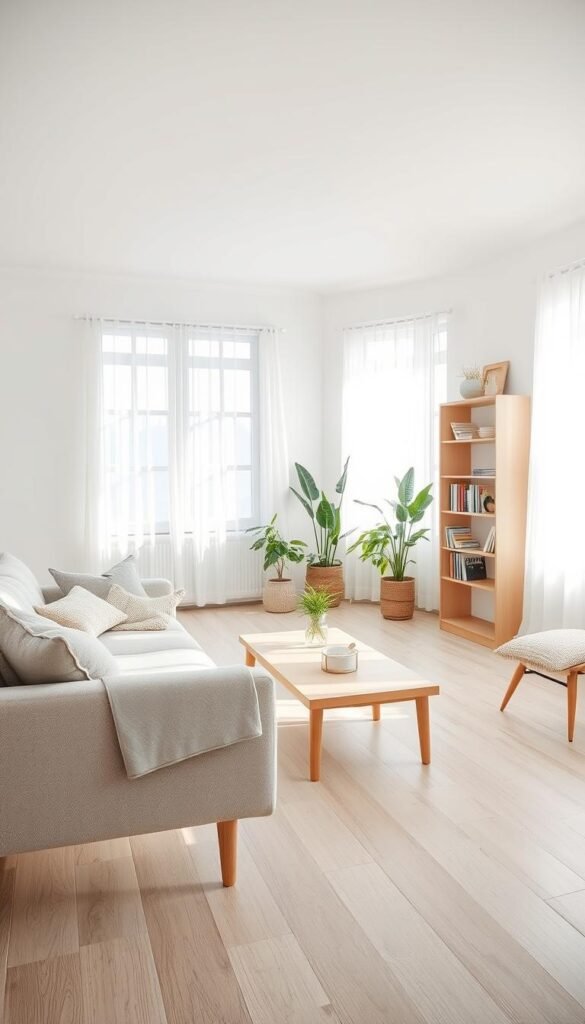
A sofa with a simple profile and comfortable cushions gives you a practical anchor for the rest of the room. Choose clean lines, neutral fabric, and tapered legs to keep the living room open, especially when floor space is limited. Where the room allows, leave about 30-36 inches for a main walking path.
Furniture also shapes what your eyes take in. Princeton researchers Stephanie McMains and Sabine Kastner studied how objects compete for space in the visual cortex. Their work offers a useful design reminder: every extra piece can compete for attention, so give each item a clear purpose.
Start with comfortable, clean-lined seating
Pick a sofa for the way you actually sit. If you curl up to read, a shallow seat may not suit you; if you sit upright, a deep lounge-style seat might feel awkward. Modern Scandinavian living room inspiration can include softened curves as well as crisp lines, as long as the shape works in your space.
Use side tables, a storage ottoman, or a coffee table with shelves when they solve a real need. A small room can benefit from pieces that do more than one job, but multifunctional furniture only helps when you use its extra feature.
Use wood and storage with intention
Visible floor beneath furniture makes a room feel less crowded. Light wood or another natural finish adds warmth, while closed storage keeps small daily items out of sight. Repeat a wood tone elsewhere, such as in a side table or frame, to make the choice feel connected.
The Wishbone Chair shows how a simple form can stay useful across changing interiors. Hans Wegner designed it in 1949, and it has been in continuous production since 1950. You do not need that chair specifically; the lasting appeal comes from a clear shape and purposeful materials.
Before you add a large piece, check these four furniture details:
- Comfortable seat depth
- A clear walking route
- Useful storage
- A wood tone repeated in at least one other piece
Bring Japandi into a modern Scandinavian mix
Japandi brings Japanese-inspired restraint together with Scandinavian warmth through simple shapes, natural materials, and purposeful furniture. This mix suits a modern living room design when each piece supports daily use rather than adding visual noise. A chair with a curved back can sit comfortably beside a straight-edged sofa.
If you enjoy the clean silhouettes of mid-century modern furniture, repeat one or two materials to connect it with Scandinavian design. Before buying a large piece, measure its footprint and mark it on the floor so you can check the walking path.
Find the Right Area Rug Size and Placement
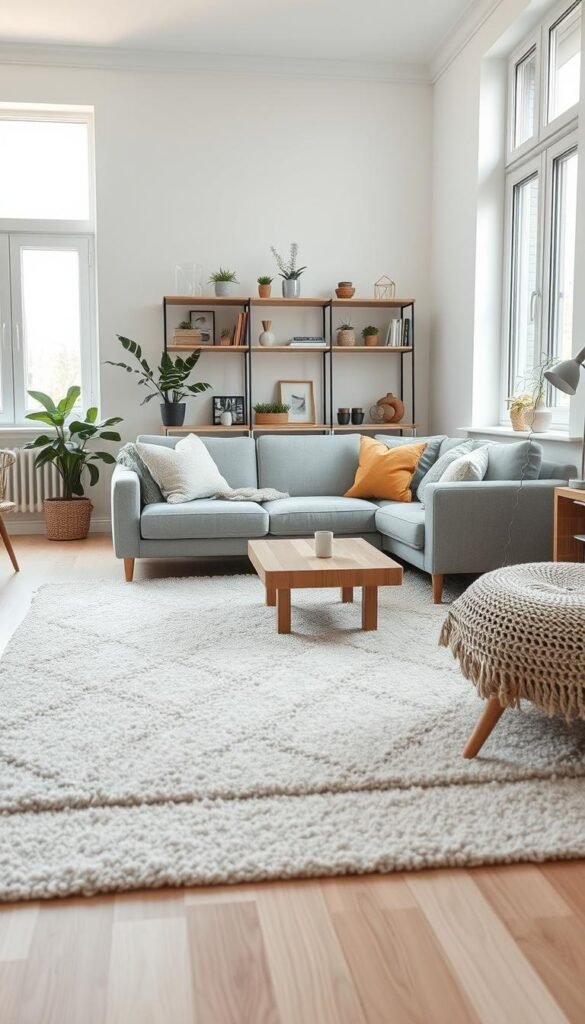
In a room 12 by 18 feet or larger, a 9-by-12-foot rug gives the seating area a clear anchor. Fit matters more than color alone: the area rug should relate to the seating and the floor around it. A small rug can work when you deliberately keep every furniture leg off it.
Choose the size according to the room and how you want the seating grouped. The table gives common sizes and placement options; use the layout as your guide rather than picking a rug by color alone.
| Rug size | Suitable room or use | Placement guidance |
|---|---|---|
| 9-by-12 feet | 12 by 18 feet or larger, or open-plan | Place under seating |
| 8-by-10 feet | 11 by 13 feet or slightly larger | Leave a 12- to 18-inch border in a defined area |
| 6-by-9 feet or 6.5-by-9.5 feet | 11 by 13 feet or smaller | Anchor the seating without crowding |
| 5-by-7 feet | Small living area or fireplace seating | Tuck under the coffee table, or place chairs nearly all the way on it |
| 4-by-6 feet | Apartment-size room or coffee-table zone | Cover most of the floor, or leave the sofa’s front legs off |
Match the rug size to the room
An 8-by-10-foot rug suits an 11-by-13-foot room or one slightly larger. In a defined living area, that size can leave a visible strip of floor around the edges. A 6-by-9-foot or 6.5-by-9.5-foot rug is better suited to rooms measuring 11 by 13 feet or smaller.
A 5-by-7-foot rug can sit beneath a coffee table in a small living room. It can also work in front of a fireplace with two chairs nearly all the way on it. In an apartment-size living room, a 4-by-6-foot rug can cover most of the floor.
Set the seating on or around the rug
For a connected seating group, fit the front legs of the main pieces on the rug without crowding the room. If you prefer a smaller rug, keep it clear of every furniture leg instead of letting it sit awkwardly beneath only one piece. Furniture placement gives you a better guide than a rug’s color on its own.
Check the room’s proportions before you settle on a size, especially when the seating area sits within a larger living space. In a defined seating area, check that the rug leaves a 12- to 18-inch floor border when you use an 8-by-10-foot size.
For an open-plan room, an area rug can mark the seating zone without dividing the whole floor. See more open-concept living room design ideas for ways to keep connected spaces visually cohesive.
Layer Lighting for Cozy Evenings and Clear, Useful Light
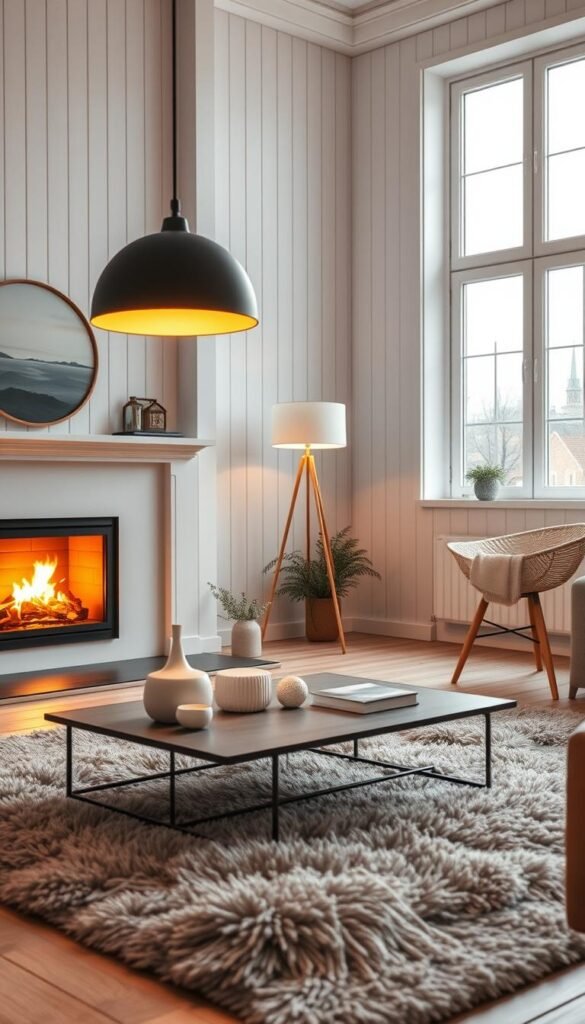
A 2700K bulb gives you a warm, golden glow, while a 3000K bulb keeps the warmth with a slightly brighter tone. Kelvins describe color temperature, or the warmth or coolness of a light source; lumens measure brightness, or the amount of light a bulb produces. Bulbs at 2700K and 5000K can both produce 800 lumens.
Choose lighting in layers instead of relying on one harsh overhead fixture. Floor, table, and overhead lights can serve different parts of the room throughout the day. Natural light travels farther when tall furniture and heavy curtains do not block the windows.
| Color temperature | Appearance | Brightness detail | Useful setting |
|---|---|---|---|
| 2700K | Warm golden glow | 800 lumens is possible | Cozy evening |
| 3000K | Slightly brighter warm tone | Choose lumens separately to set brightness | Everyday warm light |
| 5000K | Cooler white tone | 800 lumens is possible | Task lighting when a cooler look suits the space |
Choose warm bulbs by color temperature
For most living spaces, 2700K gives a golden tone, while 3000K looks a little brighter without losing warmth. You can select brightness separately by checking the lumen rating. This distinction helps you avoid choosing a bulb based on color temperature alone.
A study of more than 400,000 UK adults linked more daytime light with better reported mood and steadier sleep. Keep windows clear enough for daylight to reach deeper into the room, then add lamps where you read, work, or relax. More ideas for warm, layered lighting can also help you think through how light serves different activities.
Use an electric fireplace as an accent, not a primary heater
Electric fireplace inserts add a visual focal point and can take the chill off a cool room, but they are supplementary heat, not a primary heating system. In 2026 testing, the inserts used a nominal 1,500 watts, about the same as a standard electric space heater. Tested models plugged into a standard 120-volt outlet, though power may need to be added or moved to the installation location.
The tested inserts ranged from 23 to 36 inches wide and cost about $260 to over $900. Check the installation location and its power needs before choosing a unit. A built-in insert also needs space around the heat it produces.
Some 2700K and 3000K bulb color temperatures create warm indoor light, but brightness still depends on lumens. Take care around children and pets near an insert. Keep children and pets away from an insert’s hot vents, and leave at least 8 inches between a built-in unit and a TV or mantel.
Finish With Natural Textures, Greenery, and Personal Details
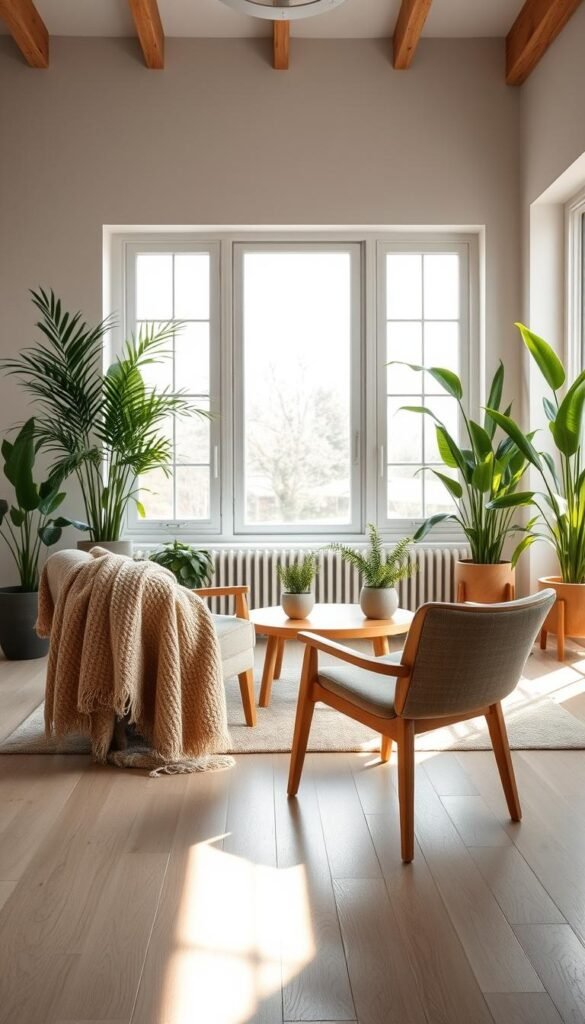
A wool throw and a woven basket can add texture while still serving everyday needs. Combine natural materials such as linen, woven fibers, stone, and wood through blankets, cushions, baskets, and a plant or branch. Choose useful decor where you can, such as a bowl for keys or a basket for blankets.
Plants bring life into a room, but they are not a substitute for ventilation. Even one leafy plant or a simple branch can add a natural note without taking over the space. If you want more soft, practical details, Scandinavian textile ideas can inspire ways to use layers of fabric and greenery.
You can group decorative objects in threes as a rule of thumb, not a strict formula. A restrained palette often uses two or three main colors, with small accents added sparingly. Leave room around each object so the surfaces do not become a collection of little distractions.
Add one larger textural element before buying several small decorations; it can make a room feel more settled.
For a calm space with a natural finish, Scandinavian ideas for natural textures offer useful inspiration beyond the bedroom. Leave one clear surface so the objects you keep have room to be noticed.
Start With One Change That Makes the Room Feel More Like Home
You can make a room feel calmer without replacing everything at once. A single useful, comfortable choice can improve your home more than filling it with new things. Build the look gradually, using what already works and changing only what gets in the way of daily comfort.
Start with the seat you use most. Notice whether it needs a softer cushion, a nearby place for a drink, or a blanket within reach. Choose one improvement for the seat you use most, then make that change this week.