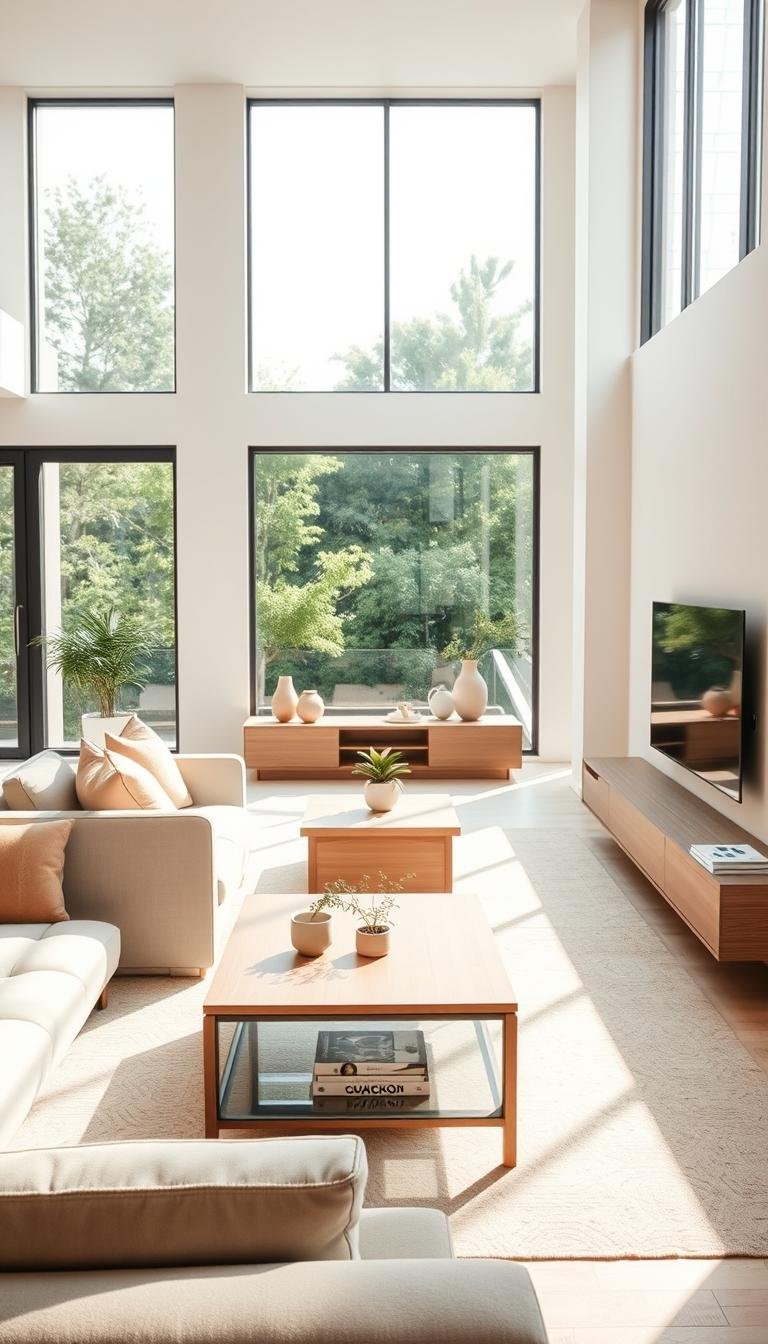
A calm minimalist living room comes from choosing fewer, purposeful pieces and giving each one room to breathe. If your home feels busy, a simpler arrangement can make everyday routines more comfortable without leaving the space bare. Minimalism means keeping what is useful, beautiful, or meaningful, not stripping away comfort. Negative space is the intentional empty area around furniture and objects that gives a room visual breathing room.
These ten practical ideas show how to use texture, natural light, and uncluttered surfaces to make a room feel settled and welcoming. You can work with the furniture you own, then make thoughtful changes as your needs become clearer. A well-chosen rug, a comfortable seat, and a clear view across the room can matter more than adding another decoration. Start by noticing which parts of your current space already help you feel settled.
Living Room Designs Minimalist: 10 Ideas for Calm and Balance
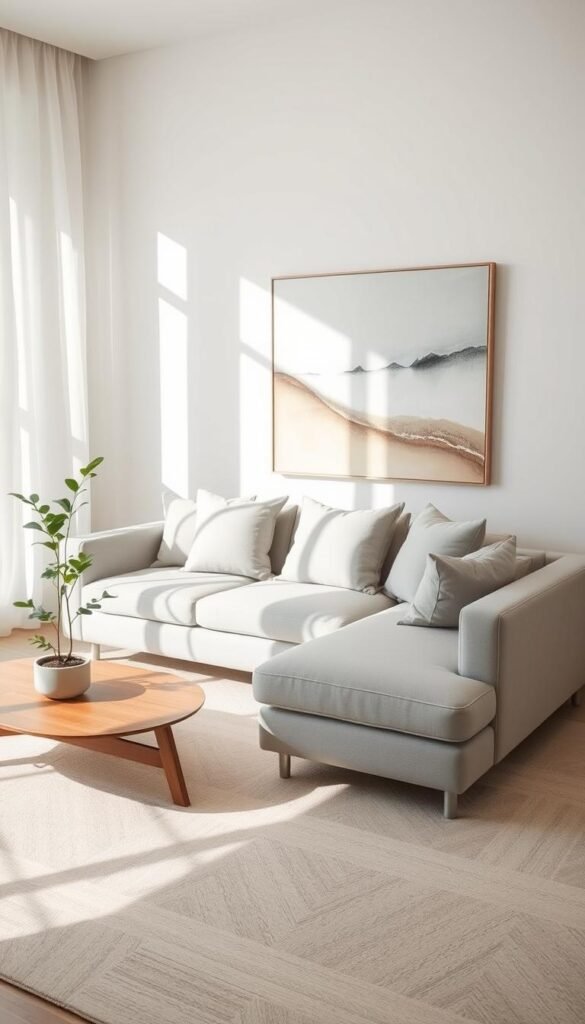
If your artwork spans about two-thirds of the sofa, it is likely to feel connected without overpowering it. Modern minimalist living room designs and simple minimalist living room designs both benefit from scale that gives each piece a clear relationship to the next. Proportion helps clean lines feel intentional rather than spare.
The 2/3 rule sizes a related living-room element at about two-thirds the size of its anchor. A coffee table around two-thirds the sofa’s length usually feels balanced, too. Measure a grouped artwork arrangement as one unit, not as separate frames.
Use the sofa to set the scale
Make the sofa your measuring point for ideas 1 and 2. Artwork spanning two-thirds of a sofa tends to look connected, while a coffee table near two-thirds of the sofa’s length leaves a useful margin at each end. A table that is too long can crowd the focal point and interrupt the room’s flow.
Group furniture and accents with intention
The 3-5-7 rule gives you a simple way to think about groupings: three large anchors, five medium supporting pieces, and seven small details. Treat it as a flexible guide, not a shopping list. Ideas 3 and 4 help you keep the main arrangement clear:
- Size art to the sofa, measuring a grouped arrangement as one piece.
- Choose a coffee table with a length that relates to the sofa.
- Build around three large anchors, such as a sofa, area rug, and bookcase; supporting pieces might include armchairs, a side table, and a floor lamp.
- Leave breathing room around the focal point so it remains easy to notice.
Face seating toward one another when conversation matters, or angle it toward a fireplace or window. A conversation-friendly furniture layout can still feel open when you leave a clear route through the room. Measure the sofa before you buy art or a coffee table, then compare the dimensions rather than guessing.
Choose a Warm, Restrained Color Palette
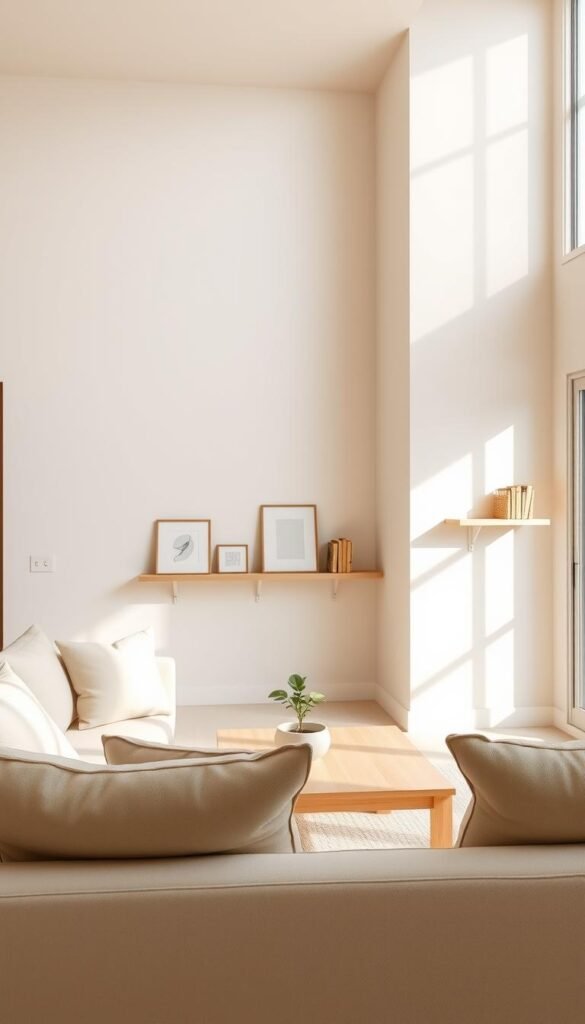
Warm neutrals such as sandy beige and soft caramel give a minimalist room a softer base than stark white. A restrained color scheme lets furniture and objects stand out without making every wall compete for attention. Warmth can come from a few related tones, not a long list of colors.
Choose one quiet base and add only a small number of muted accents. The 2026 HGTV Home by Sherwin-Williams Color Collection of the Year is Honest Essentials, with Universal Khaki (HGSW6150) as its Color of the Year. The sandy neutral is presented as a foundation for materials such as stone and wood.
| Color moving away from | Calmer 2026 alternative | How to use it |
|---|---|---|
| Pale butter yellow | Ochre, tobacco, or warm caramel | Wall color |
| Saturated denim blue or bright teal | Subdued blue with gray, mineral, or earthy-green undertones | Textiles or art |
| Highly saturated pink | Dusty rosewood | One accent |
| Off-white | Mushroom, caramel, or creamy tones | Wall or upholstery |
| Sage green | Muted chalky mint | A restrained accent |
Build from sandy and creamy neutrals
Honest Essentials also includes Neutral Ground (HGSW7568), Cordovan (HGSW6027), Lemon Chiffon (HGSW6686), Creamy (HGSW7012), Griffin (HGSW7026), Reddened Earth (HGSW6053), Still Water (HGSW6223), Hazel (HGSW6471), and Secret Garden (HGSW6181). Think of these as examples, not a required shopping list. Universal Khaki’s sandy neutral tone can pair with natural stone or wood.
Add a muted accent instead of a jolt of color
A limited palette can still show personality. Icy blue remains an accent option for 2026, while WGSN named Transformative Teal its 2026 Color of the Year. Amber, also called burnt caramel, blends rust, mustard, and brown. Apply these colors in modest doses rather than spreading them across every surface.
- Repeat one neutral across large surfaces to give the room a steady base.
- Limit accent colors to a small number of related tones.
- Test color in the room’s actual light, since daylight changes how a shade reads.
For more ideas on coordinating neutrals, a calm neutral palette can offer useful combinations for an adjacent room. Test a paint sample at different times of day before committing to a full wall.
Layer Natural Materials and Texture
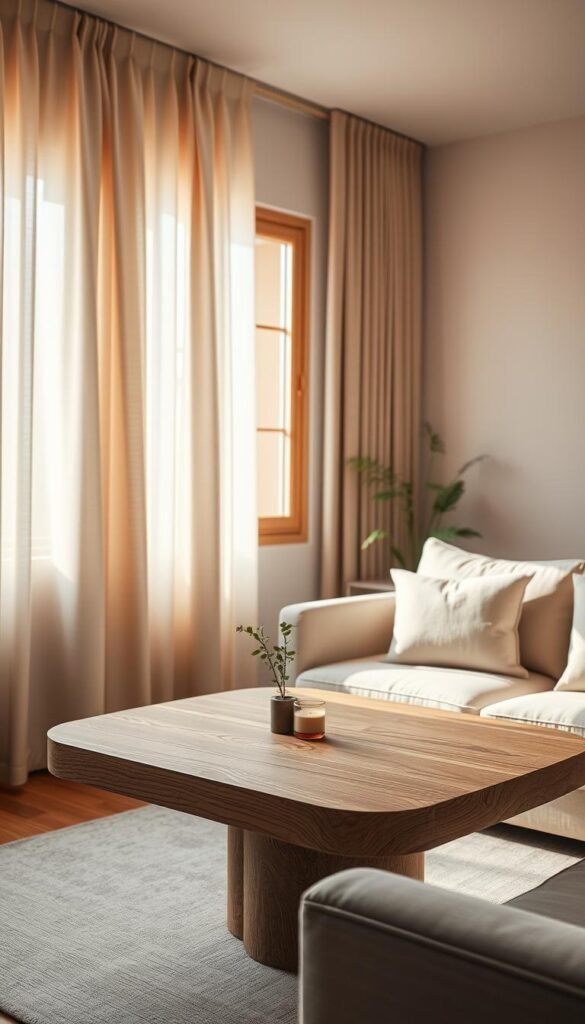
A linen curtain beside a warm wood table gives a quiet palette two different textures to work with. Pairing tactile materials makes minimalist living feel comfortable, while keeping the number of finishes in check prevents visual noise. Contrast gives a simple room depth without asking for more objects.
Use two or three complementary textures instead of many competing finishes. Linen or mohair can sit beside stone, plaster, jute, wool, or matte ceramics. A textured wall or one woven accent can add depth without filling every surface.
Warm and medium wood tones include white oak, walnut, elm, hickory, and cherry. Choose one or two that work with the room’s existing finishes, then let a contrasting material bring out the grain. Curved furniture can also soften a space without adding another color or pattern.
Warm minimalism puts comfort and material character ahead of stark reduction. Western minimalist design found a modern footing in the early 20th century, when the Bauhaus movement emphasized form, materiality, and texture. Japanese design traditions also shaped minimalist interiors through simplicity, restraint, and natural materials.
Natural materials and layered textures can make a bedroom feel comfortable without crowding it, and the same approach works in a living room. Choose one tactile finish to repeat, then let the other materials provide contrast rather than competition.
Make a Small Living Room Feel Open
In a compact room, a sofa in the 72-84-inch range can leave more layout options than a standard 90-96-inch sofa. Your furniture needs to support movement as well as seating, so a smaller footprint can make the whole space easier to use. Clear routes matter as much as the pieces themselves.
Keep furniture surfaces to no more than 60% of the room’s floor area. For main traffic corridors, aim for 30-36 inches of clearance; rooms under 150 square feet are recommended to keep 18-24 inches of walkway space.
Choose seating that fits the footprint
A loveseat is 52-64 inches wide, and armless chairs save 6-8 inches per side compared with traditional seating. Track-arm sofas and sectionals save 4-6 inches of width compared with bulkier arms. An 80×80-inch sectional can suit a corner layout when you want more seating without a long sofa.
Protect pathways and use vertical space
Three practical layout ideas can help you make room for daily movement:
- Select compact or armless seating that fits the room’s actual footprint.
- Use nesting or stackable pieces that can move aside when you need open floor space.
- Keep clear pathways and use vertical storage to preserve the floor area.
Floating furniture 3-4 inches from walls can make a compact room feel less confined. Floating shelves mounted 3-4 shelves between studs can hold books and a few decorative objects. For a room with multiple jobs, try multifunctional tables, built-in bench seating, or a translucent partition.
More ways to open up a living room include keeping paths clear and using the space above windows. Tape out the sofa and main walking route on the floor before you commit to a layout.
Choose Furniture That Earns Its Place
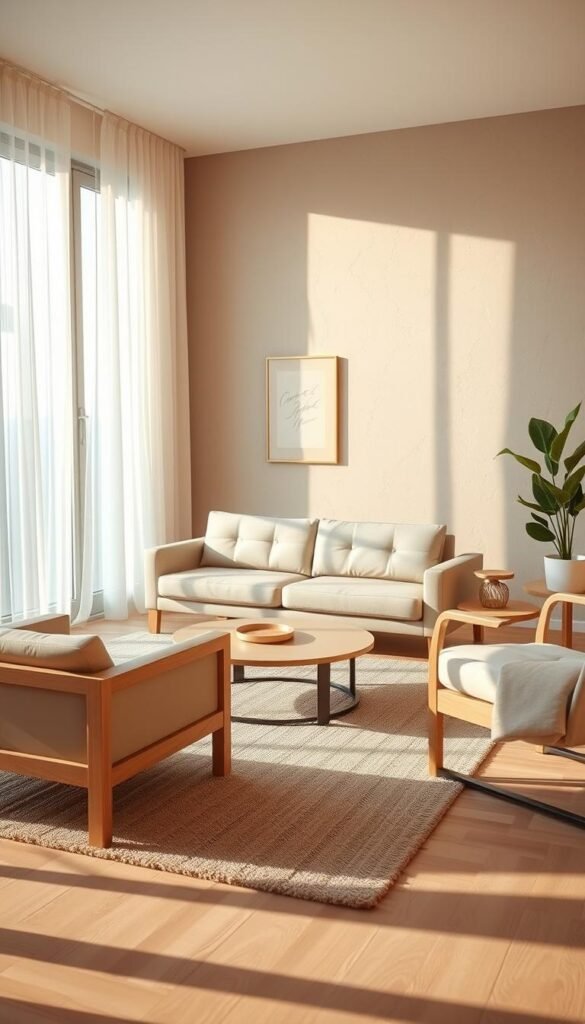
A sofa earns its place when its dimensions, function, and upholstery suit how you actually use the room. Compare the size and useful features with the price, rather than choosing by appearance alone. Fit first can keep a minimalist room from feeling crowded or costly.
Martindale cycles of 20,000-30,000 are a reference range for fabrics generally considered suitable for everyday residential use. The abrasion test can help you compare upholstery, though comfort and care needs still matter.
| Model | Size or depth | Listed price | Useful fit detail |
|---|---|---|---|
| Article Abisko | 91 inches long | $1,199 | Visually slim for narrow living rooms |
| Burrow Nomad | Modular | $1,462 sale; $1,949 list | Easy assembly and rearrangement |
| West Elm Eddy | 82 inches wide | About $799-$1,549 before promotions | Compact width |
| Joybird Briar | Slim arms | $1,520 sale | Tailored, mid-century-inspired profile |
| Floyd Sofa 2.0, three-seater | 34-inch seat depth | $1,752-$2,190, depending on membership | Choice of membership pricing |
The 20,000-30,000-cycle Martindale range offers a useful upholstery reference when comparing a sofa for regular use. A minimalist living room on a budget can start with fewer pieces, careful measurements, and multifunctional furniture.
The CB2 Corroy 78.25-inch Natural Linen Sleeper Sofa lists at $2,079 on sale and $2,599 at regular price. The Povison 114.17-inch Minimalist Lamb Fleece Sofa costs $2,999 before coupons, has a 33.46-inch seat depth, and comes with removable, washable cushion covers. The Povison Vintage Chenille Waterproof Loveseat costs about $1,999, depending on size and region, and has removable cushion covers.
Sale prices are not permanent prices, and configurations can affect what you pay. Check the current price and configuration with the seller before making a purchase, since listed promotions and options can change.
Let Natural Light Shape the Room
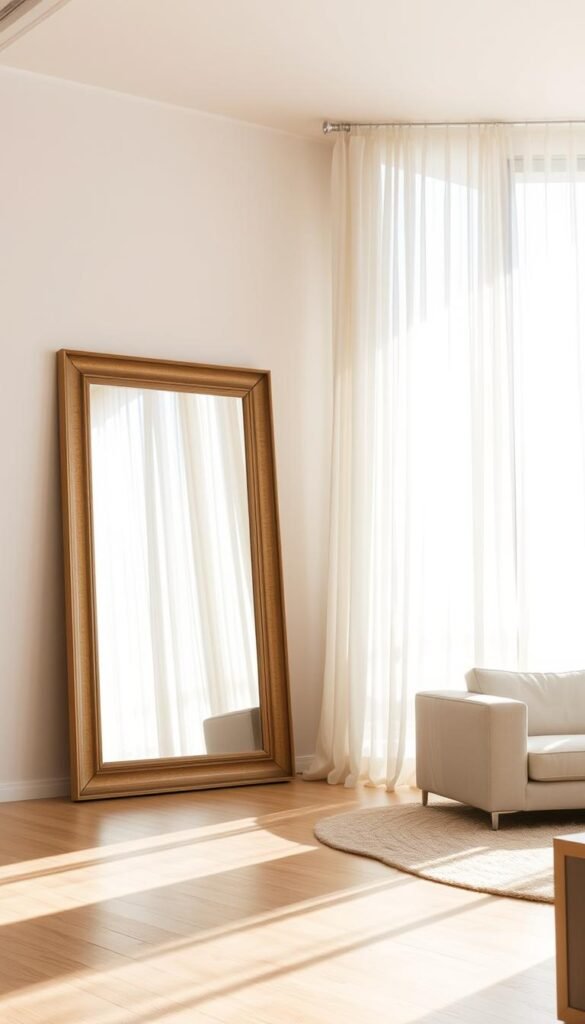
Natural light can make a pared-back room feel more open without adding another object. Sheer curtains soften daylight, and a clear sightline to the windows lets it travel farther into the room. Daylight also reveals the surfaces and shapes you have chosen.
A practical lighting plan combines ambient, task, and accent light. Ambient light fills the room, task light supports reading or other focused work, and accent light draws attention to a feature. A clean-lined floor lamp, recessed lights, or a simple pendant can serve these roles.
Mirrors can reflect daylight into a dimmer part of the room, especially when placed across from or beside a window. Shaped openings also influence the direction and quality of light, so consider how a doorway, arch, or window frames the view. One continuous feature, such as a ribbon of lighting or a material that travels across a wall, can become a focal point without scattered accents.
For evening comfort, warm bulbs in the 2700K-3000K range soften the look of white walls. Layering light gives you more control than relying on one overhead fixture. A thoughtful mix of lighting and accents can add personality without taking over the room.
- Keep windows visually clear so daylight can enter.
- Position a mirror to reflect daylight toward a darker area.
- Use warm bulbs for comfortable evening light.
Turn on each light source after dark and check whether seating, reading, and walking areas are all lit comfortably.
Edit Decor and Hide Everyday Clutter
A calm room is easier to maintain when the everyday things have a place out of sight. Built-in shelving, a sideboard, or a concealed TV unit can keep belongings close without leaving them on display. Easy access still matters, so use baskets for items you reach for often.
Keep each surface to a maximum of three objects, grouped in an odd number. The limit gives a table or shelf room to breathe, while a small, intentional arrangement still feels personal.
Keep each surface to a maximum of three objects, grouped in an odd number.
Give daily-use items a home
Remotes, charging cables, and daily-use items do not need to live on every surface. Assign them a drawer, a basket, or a compartment in the TV unit, so they remain easy to find without becoming the room’s main display. Useful storage and considered decor can make that habit easier to keep.
Display fewer, more meaningful objects
A plant, a piece of artwork, or a personal object can bring more character than several decorations chosen just to fill a blank spot. Dieter Rams’s “less, but better” principle favors fewer, better-considered objects. William Morris offered a simple test: keep what is useful or what you believe is beautiful.
Choose objects that matter to you, then let empty areas remain empty when they serve the room. That choice helps the furniture and meaningful details feel more visible. Choose one surface to clear today and keep only the objects you use or genuinely value there.
Make One Calm Change Today
A more peaceful room does not require a full makeover; one well-chosen change can shift how the space feels. Intentional choices let you keep comfort while making the home easier to live in. Start small enough that you can finish today.
Measure the sofa wall and remove or relocate one item that does not serve the room. You might move an unused table to another room or clear a view that feels blocked. Give the change a few days of ordinary use before deciding whether the arrangement works.
Measure one key area, choose the change that matters most, and give the room time to work for you.