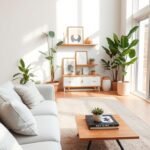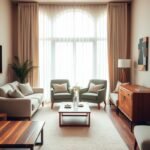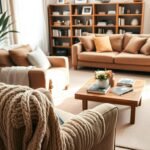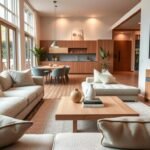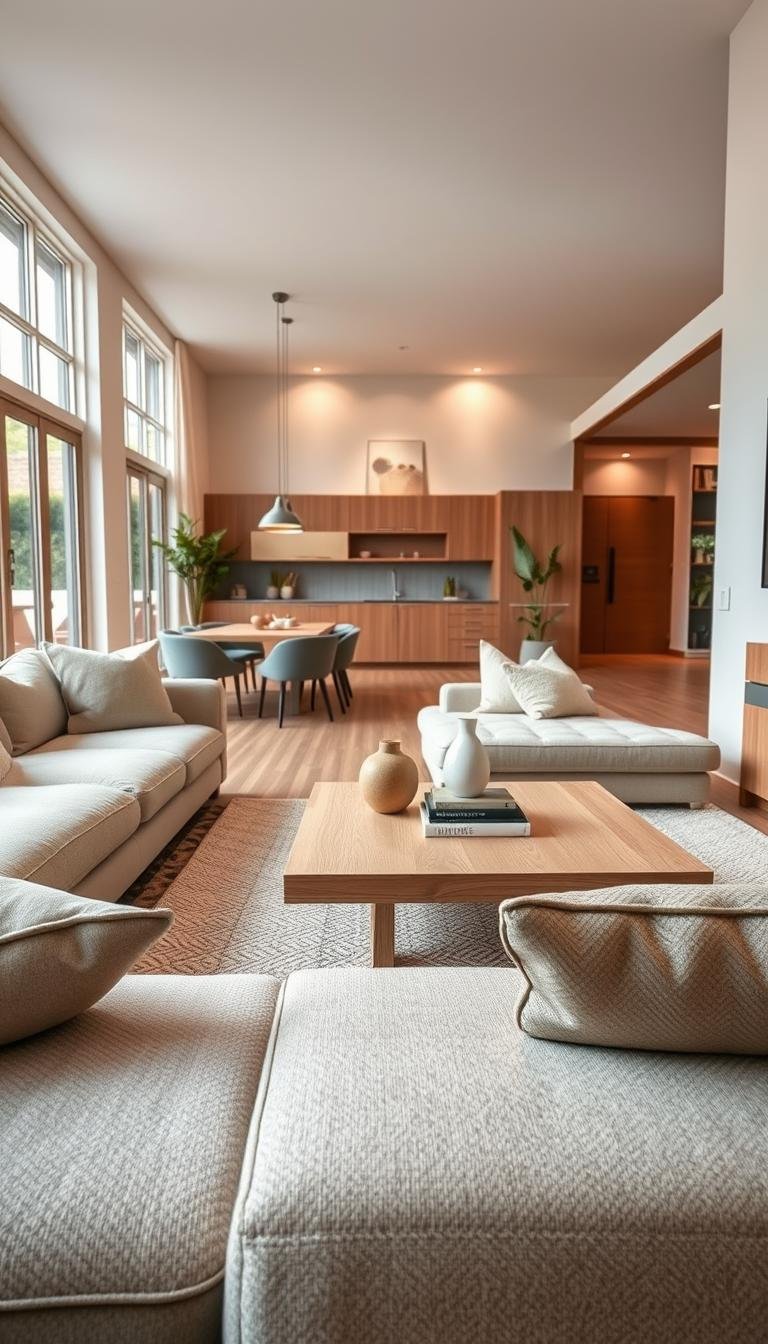
A polished room can still feel relaxed enough for a movie night, a good book or a full house of guests. Elegant modern living room inspiration can help you shape a home that feels considered without becoming precious. You can adapt these ideas to your existing furniture, artwork and favorite finds, rather than buying a matching set.
Negative space is the clear, intentionally unfilled area around furniture and decor that helps a room feel balanced rather than crowded. That open area gives each useful piece a little breathing room, while comfortable materials keep the space from feeling staged. The aim is a room that works for ordinary routines as well as special evenings, with choices that make sense for your home.
Start by noticing what you want the room to feel like during an ordinary day, not just how it might look in a photo.
What Makes a Modern Living Room Feel Elegant?
Elegance comes from a few intentional choices, not from making every object look formal. A modern living room feels polished when useful furniture, clean lines and personal details share a clear purpose. Comfort matters as much as appearance, so the room should invite you to sit, read and spend time with other people.
A restrained foundation and a few expressive details make a room feel elegant without turning it into a showroom. Classic modern style often favors sleek surfaces and simple forms. Modern Organic interiors commonly pair natural materials such as wood with browns, whites and plants, while Midcentury Modern is known for its recognizable shapes and functional furnishings.
Leave at least one surface or corner visually quiet so the strongest detail has room to register.
These are distinct styles, though all three can use clean lines and practical furniture. You can borrow from more than one, provided the pieces feel related through shape, material or color. For a closer look at purposeful furniture and warm wood, explore Midcentury living room layout ideas.
One sculptural chair, striking artwork or a memorable fixture can give the room personality. You do not need to decorate every shelf or surface to make the design feel finished. A quiet corner lets your chosen detail stand out without competing with the rest of the room.
Start With a Palette That Feels Calm, Not Flat
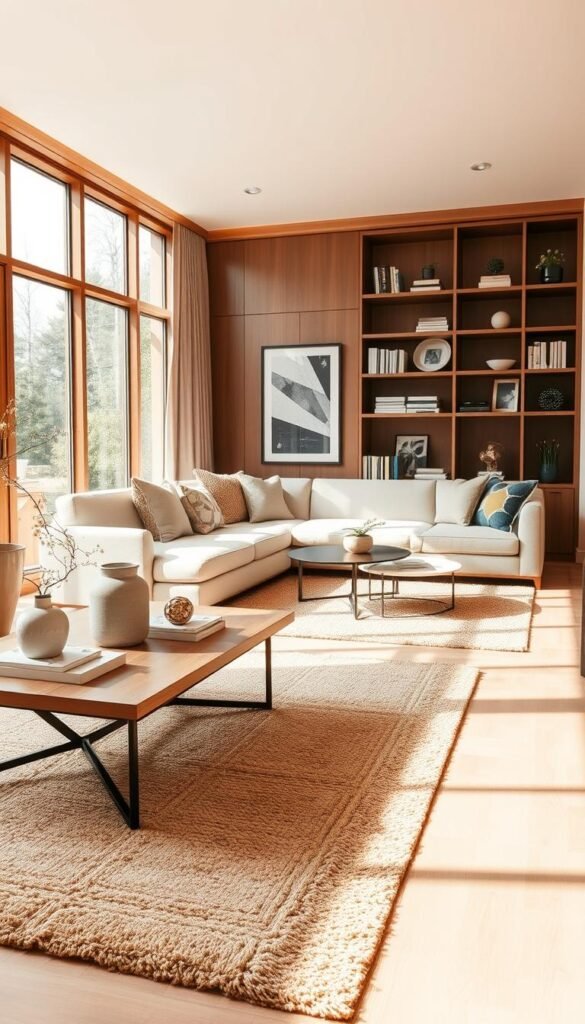
A warm neutral base makes it easier to change art, pillows and smaller accents without rebuilding the whole scheme. Warm whites, creams, beige and soft gray create a calm foundation for living rooms, but the right mix should still feel like your home. Related shades add depth without making the room busy.
Paint can shift as the light changes, so consider the wall color alongside trim and nearby finishes. Choose a few shades with similar warmth, then sample them on walls and woodwork. Check each sample in daylight and again under evening light before you decide.
Build a warm neutral foundation
Look at the undertones rather than relying on a paint name alone. A white with a warm cast can sit comfortably beside beige upholstery, while a soft gray may work better with cooler stone or metal. Benjamin Moore’s 2026 Color Trends palette includes Silhouette AF-655, a burnt umber with charcoal notes, alongside Swiss Coffee OC-45, Raindance 1572 and Narragansett Green HC-157.
HGTV Home by Sherwin-Williams named Universal Khaki HGSW6150 its 2026 Color of the Year and included it in the Honest Essentials collection. Treat these named paint colors as examples, not a prescription. A sample that looks gentle in one home may appear much stronger in another room’s light.
Add one grounded accent color
Choose one deeper color to give the neutral palette a clear point of contrast. Charcoal, forest green, cognac and terracotta can add depth through a single wall, upholstery or a small group of accessories. If you prefer a changeable accent, start with pillows or a throw instead of committing to a large painted surface.
- Choose a warm neutral base for walls and larger surfaces.
- Select one grounded accent color for contrast.
- Test paint samples in the room’s daylight and evening light.
Test paint samples on more than one wall before committing, because daylight can shift how the same shade reads.
Choose Furniture That Balances Comfort and Clean Lines
The right sofa is the one that fits your body and your floor plan, not just the one with the most dramatic outline. Compare seat depth, overall width and upholstery with the way you actually sit. Your habits matter: a deep seat may suit lounging, while a more upright cushion can be easier for conversation.
Check the sofa’s full dimensions and configuration before choosing it for your room. Modular flexibility can help when you expect to change the layout or need a chaise on one side. A sculptural curve can soften clean lines, while chenille, velvet and bouclé bring different textures to the furniture mix.
The options below show how size, shape and function can vary. Listed prices are examples for the named models, not a guide to every sofa in that style.
| Model | Stated price | Useful feature |
|---|---|---|
| Burrow Union 5-Seat Sectional | $3,600 | L-shape, U-shape or separate chaise seating |
| HERNEST Brisa | $1,619 | 84-inch width and 24-inch seat depth |
| Povison Retro Hand-Tufted Beige Chenille Sofa | Approximately $1,599-$2,498 | 106.3-inch width and included ottoman |
| CB2 Gwyneth Ivory Bouclé Swivel Chair by goop | Approximately $999-$1,499, depending on retailer | Swivel chair |
The Brisa has a sculptural curved silhouette, while the Union can be configured in three ways. For a softer, sink-in feel, the West Elm Harmony Chaise Sectional is a cloud-like comfort pick. The CB2 Ceva Performance Velvet Sofa offers a luxe velvet statement style.
The Burrow Union 5-Seat Sectional is listed at $3,600, which gives you a specific reference point when comparing configurations. Upholstery also affects daily use: consider how the fabric feels, how you use the room and whether you prefer a smooth or nubby finish.
Before choosing a deep seat or oversized sectional, check that you can still reach the coffee table and walk around the seating group.
Arrange Furniture for Conversation and Clear Paths
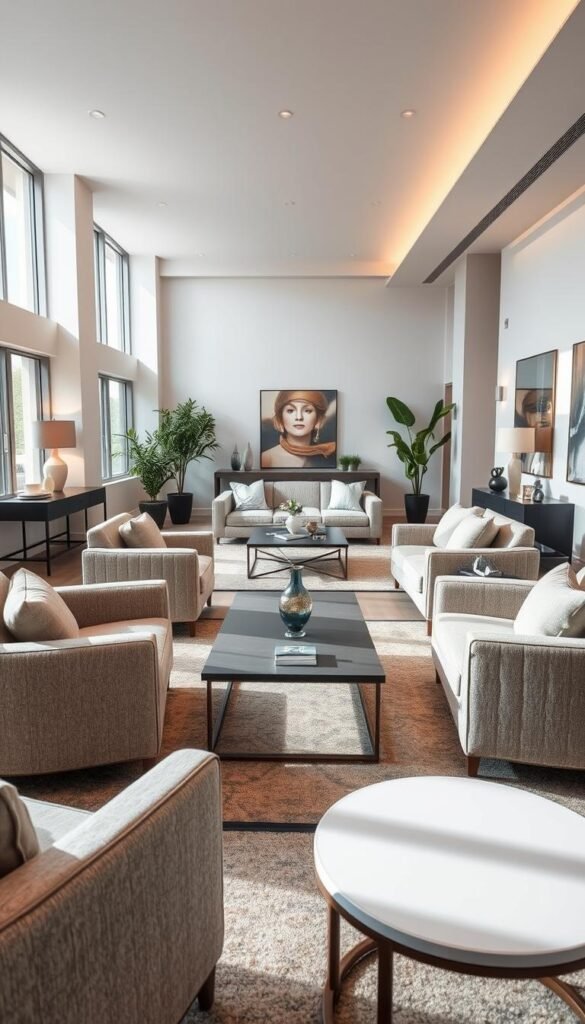
A room can look spacious on paper and still feel awkward if the path between the door, sofa and chairs is blocked. Facing or angled seats make it easier to talk, while open routes let you move through the living room without sidestepping furniture.
Keep the seating connected and protect the route you use most often. A fireplace or TV can serve as a secondary focal point, but the conversation area should still let people see one another. The arrangement can respond to how you watch, read and gather in the room.
Set up a conversation area
Place the sofa and chairs so people can talk without twisting toward one another. Seats can face across the room or turn slightly inward, depending on the shape of your furniture. Keep living-room seating pieces about 3.5-10 feet apart, adjusting within that range to suit the room and how close you like to sit.
A focal point gives the arrangement direction, but it need not dominate every seat. If your TV is important for daily use, angle a chair toward it while keeping the sofa and another chair in a conversation area. For more guidance on seating that faces inward and layouts that flow, see modern chic living room ideas.
Keep circulation routes open
Allow 30-36 inches between large furniture pieces for a walkway when possible. In a smaller living room, 18-24 inches may be the workable range. Pulling a sofa 3-5 inches from the wall can make its placement feel intentional, rather than as if the furniture was pushed aside.
- Protect the main route from the door through the room.
- Keep the seats close enough to feel connected.
- Test door swings before settling on a furniture position.
- Leave space for people to stand up without shifting a chair.
Walk your usual route through the room after arranging furniture, carrying a mug or laundry basket to catch tight turns.
Get the Rug and Coffee Table Sizes Right
A rug that gathers the seating together makes the arrangement feel like one purposeful zone. For most living rooms, choose a rug at least 8 by 10 feet, large enough to reach the sofa’s front legs and include all chairs. A connected seating area feels more settled than furniture floating around a small rug.
Leave 16-18 inches between the sofa and coffee table. That gap keeps the table within reach without crowding knees. Choose a table at least half as long as the sofa, with a height within 4 inches above or below the top of its seat cushions.
| Element | Starting point | How to adapt it |
|---|---|---|
| Rug under seating | Sofa front legs and all chairs | Keep the whole seating group connected |
| Rug size | At least 8 by 10 feet for most living rooms | Choose a size that fits the furniture group |
| Rug-to-wall gap | About 24 inches in a large room; 10-18 inches in a smaller room | Leave more visible floor in a compact room |
| Sofa-to-table gap | 16-18 inches | Keep the table reachable without crowding knees |
| Coffee-table proportions | At least half the sofa’s length; within 4 inches of seat-cushion height | Check both length and height beside the sofa |
A coffee table should be easy to reach from the sofa, yet leave enough room for knees and movement. The rug-to-wall gap can be about 24 inches in a large room or 10-18 inches in a smaller one. These are starting points, so let the furniture group and visible floor guide your final choice.
Most living rooms need at least an 8-by-10-foot rug, though the seating layout determines how that size works in your space. Tape the rug and table outlines on the floor before ordering, then check the door and drawer clearances.
Layer Lighting for a Softer, More Useful Room
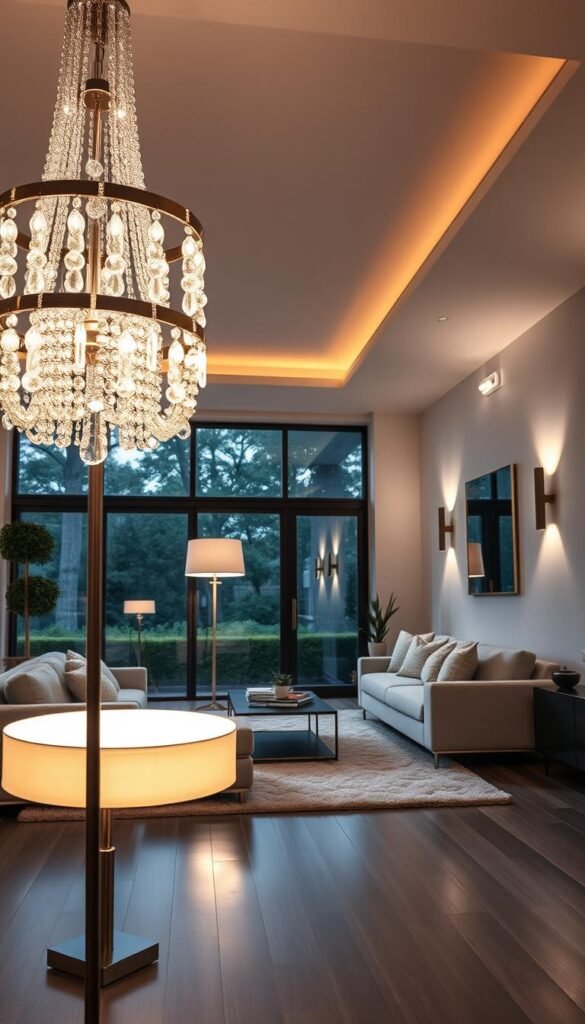
One ceiling fixture rarely gives you the comfortable, flexible light needed for relaxing, reading and showing off the room. Layer ambient, task and accent lighting so you can shift the mood and function throughout the day. Different layers keep the room useful without relying on one bright overhead light.
Use ambient light for general illumination, task light for reading, and accent light to highlight art or architecture. A floor lamp can serve a reading chair, while a sconce or small spotlight can draw attention to a wall feature. Choose fixtures for both their light and their visual character.
Combine ambient, task and accent light
Ambient light fills the room, often from a ceiling fixture or several lamps. Task light should reach the place where you read or work, without shining directly into your eyes. Accent light adds a focused glow to artwork, shelves or architectural details, giving the room more depth after dark.
A chandelier can be a statement feature, but its scale should suit both the room and ceiling. In a 14-by-18-foot room, a fixture about 32 inches across is a starting point. For ceilings 9 feet or higher, scale up by a few inches and consider a longer drop.
Place fixtures at comfortable heights
At a floor lamp, position the shade so it hides the bulb from someone seated. The light should fall around seated eye level, where it can support reading without glare. Wall sconces usually sit 5-6 feet above the floor, with 3-6 inches between a sconce and nearby art or mirror edge.
| Fixture | Placement guide | Measurement or check |
|---|---|---|
| Chandelier | Room and ceiling size determine scale | About 32 inches across for a 14-by-18-foot room |
| Floor lamp | Shade blocks bulb from seated view | Light around seated eye level |
| Wall sconce | Set height from floor | 5-6 feet |
| Sconce beside art | Preserve a visual gap | 3-6 inches |
Check glare from the sofa and reading chair at night, not only the fixture’s appearance during the day.
Give Walls and Fireplace a Strong Focal Point
Choose the first thing you want someone to notice when they enter, then let the other wall details support it. A fireplace surround, wall-mounted TV or large artwork can anchor the view. One clear focal point helps your living room feel composed instead of divided between competing features.
A single visual anchor gives the rest of the wall a job: support it, not fight it. A media wall can center the TV, while concealed TV placement lets the screen recede when you are not watching. If the fireplace already draws attention, keep nearby decor simpler and let its materials carry the view.
A sideboard or credenza can balance a focal wall and hold everyday items such as games, remotes or books. The Article Seno oak sideboard measures 48 inches wide and was listed at around $899. The Crate & Barrel Libby natural credenza measures 72 inches wide and was listed at around $1,699.
Those differently sized storage pieces show how the width can change from one design to another, but neither is a universal fit. Consider the wall, the items you need to store and how the piece relates to nearby furniture. A wide credenza may give a long wall visual weight, while a narrower sideboard can suit a tighter stretch.
For more ways to use a focal wall, consider modern luxury wall art ideas, including oversized art and mixed display styles. Keep the strongest element easy to see, and avoid crowding it with several equally bold pieces.
Measure the wall and the route into the room before committing to a wide storage piece.
Add Texture, Curves, and Natural Materials
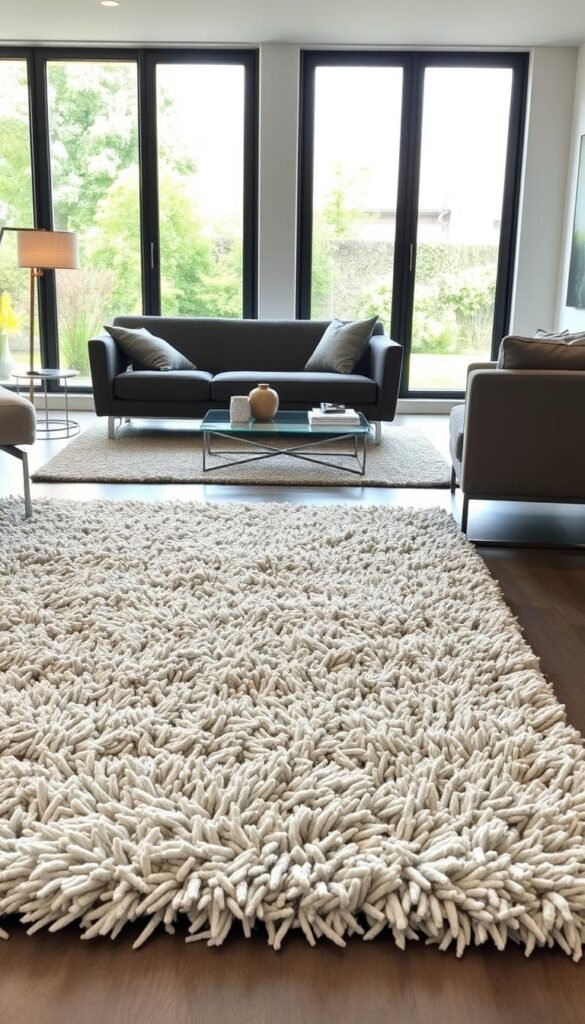
A room with polished surfaces and straight edges often feels more inviting once you add a soft, touchable counterpoint. Texture gives modern living a sense of warmth without changing the clean lines that make the furniture feel current. Tactile contrast can come from a single textile or a mix of natural materials.
Pair hard finishes with soft layers so the room feels balanced to both the eye and the touch. Wood, stone, metal and concrete bring structure; wool, linen, velvet, bouclé and leather add softness. Try a few combinations that suit your style rather than using every material at once.
Balance hard surfaces with soft layers
A wool-and-silk Jan Kath rug can soften an industrial-leaning living room. Raëd Abillama’s design pairs that plush surface with harder industrial elements, showing how a room can feel warm without losing its architectural edge. You can create a similar contrast with a woven throw, a nubby pillow or a linen curtain.
- Stone with wool.
- Metal with velvet.
- Wood with linen.
- Concrete with bouclé.
Natural textures do not need to match exactly. A smooth wooden arm beside a soft cushion feels more layered than a room where every surface has the same finish. If you like earthy seating, tan sofa decor ideas offer ways to combine warm neutrals with wood, linen and leather.
Mix rounded shapes with straight lines
Curves help soften a room built around straight walls and linear furniture. Try a curved chair, a rounded coffee table or an organic lamp beside cleaner architectural lines. The shape adds movement without asking you to fill every open corner with decor.
Repeat one material or shape in two places, such as a rounded lamp and a curved chair, to make the mix feel intentional. Repeat a favorite texture or curve once elsewhere in the room so it feels connected rather than like a one-off accent.
Make a Small Living Room Feel Open
In a small room, showing more floor and keeping the main route clear can matter more than adding another decorative piece. A modern living room design for a small house works best when the furniture fits the actual floor plan, rather than when you simply scale down every full-size item. Useful proportions make the room easier to live in.
Use the walls for display and keep the floor visually light. A wall-mounted TV frees up floor space, while elevated-leg furniture lets more of the floor remain visible. Compact two-seat sofas are typically about 60-72 inches wide, though exact dimensions vary by design.
Use the walls and vertical space
High shelving can hold books and a few favorite objects without taking up the same floor area as a wide bookcase. Edit open shelves carefully, since too many small items can make a compact room feel busy. A mirror placed to reflect natural light can brighten the space and increase its sense of openness.
If you want storage without a heavy look, use vertical space for display and keep the items you reach for most within easy reach. A wall-mounted TV also avoids the visual bulk of a large media cabinet. For more ideas on built-in storage and an airy layout, explore practical Midcentury room layouts.
Keep the floor visually light
Raised-leg seating exposes more flooring and gives the furniture a lighter appearance. A compact sofa can leave room for the activities you actually use the living room for, rather than occupying the whole space. Round or hexagonal coffee tables can help when sharp corners interrupt circulation.
Consider how the sofa, table and storage work together, not just whether each piece is small by itself. A tiny sofa beside an oversized table can still make the room feel crowded. Measure the narrowest doorway and turn on the delivery route before selecting a sofa with a fixed, oversized frame.
Bring Personality Through Art and Decor
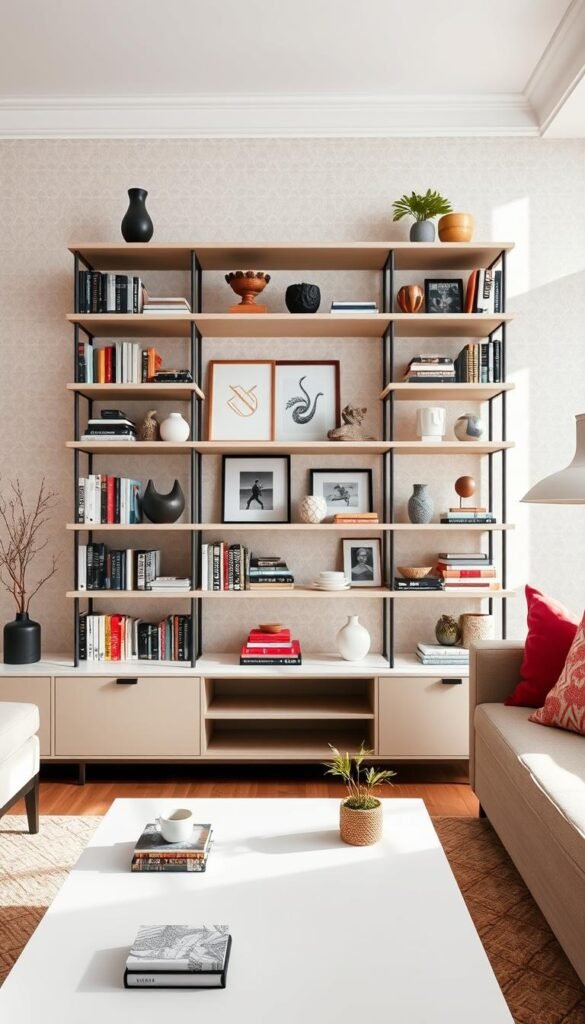
The most memorable decor usually says something about the people who live there. Artwork, books and collected objects can make a living room feel personal while keeping the overall design composed. Meaningful pieces tend to have more staying power than accessories chosen only to fill an empty spot.
Give each favorite object enough breathing room to be seen. An oversized piece above a sofa can anchor the wall, while a three-piece grouping can feel deliberate without using identical art. The “rule of three” groups objects or artworks in threes, but different sizes and subjects can keep the display from looking overly matched.
Give artwork room to breathe
Choose artwork that suits the furniture beneath it, then let the two read as one grouping. LP & Co. displays three similar-but-different paintings with picture lights, a useful example of repeating a format without making each work identical. Picture lights can add focus when a piece needs its own glow, but they are not essential for every wall.
Browsing elegant modern living room inspiration images can help you notice shapes and arrangements you like. Use those images to identify a direction, not to copy every object in another home. You might save a large abstract painting, a quiet landscape or a mix of framed prints, then choose what feels right in your own room.
Style shelves with a clear point of view
Books, ceramics and collected objects make shelves feel lived in. JAM uses high shelving to display collectibles, books and artwork, an example of using vertical space for a personal display. Leave some shelves partly open so the objects have room to stand out rather than blending into a wall of small items.
Use cozy Pinterest living room ideas as a prompt to save rooms with warm textiles or personal objects. Then keep only the details that suit your routines and the furniture you already own.
- Choose one focal piece.
- Vary the scale of nearby objects.
- Repeat one color in more than one place.
- Leave breathing room around display items.
- Use picture lights only where they help.
Keep the objects you reach for or genuinely enjoy seeing, and edit out pieces that only add visual noise.
Elegant Modern Living Room Inspiration for Everyday Living
Choose one room mood first, then borrow only the details that suit your home and habits. A quiet scheme can make everyday living feel calm, while a bolder approach can bring energy through color and shape. Your own routine should guide which direction feels comfortable enough to live with.
Start with one clear mood and keep the remaining choices in service of it. You can build either concept around the furniture you already own, then add a few pieces that strengthen the feeling. The result should reflect your taste, not just a striking image or a current trend.
A quiet, warm-neutral scheme
Warm white or beige walls, natural wood and a soft rug create an easy foundation. Add one sculptural seat to give the room a focal shape, then use restrained black or brass accents for definition. The mix can feel polished without making the room formal, especially when the textiles invite you to settle in.
A tan sofa can work with earthy colors, navy or greige, depending on the look you want. Keep the larger surfaces calm, then let a few smaller objects carry more contrast. Natural wood and soft fabrics help a neutral room feel layered instead of blank.
A bolder room with edited color
Jewel-toned upholstery or a deep wall color can create a vivid living room without requiring a bold pattern on every surface. Balance the color with simpler furniture and fewer patterns, so the strongest shade can do its work. The room can feel dramatic while still being easy to use.
Uchronia’s Paris apartment uses ombré walls, bold colors and curves for an expressive approach. Summer Thornton’s Chicago living room combines jewel-toned seating, pendants and wallcovering, offering a distinct, layered direction. Both examples show how color can shape the room, though your own version can use fewer elements.
Use Pinterest as a practical visual-board exercise. Elegant modern living room inspiration on Pinterest can help you collect a coherent direction; modern Pinterest living room ideas can be sorted by shape or material. Screen aesthetic Pinterest living room ideas for colors you will still enjoy living with, and adapt living room ideas for 2026 by borrowing one current detail rather than replacing a whole scheme.
Choose a mood you can live with every day, then edit out details that compete with it.
Save a small set of references and look for the repeated colors, shapes and materials before making a change.
Make One Change That Improves the Whole Room
A room feels more considered when its most important choices support the way you actually use it. You do not need a full renovation or a complete matching set to make your home more comfortable. A useful change can be as small as improving a reading corner, clearing a walkway or giving an existing piece a better backdrop.
Pick the problem you notice most often, then address that one thing first. The best update is the one that makes the space work better and still feels like your style. Pick one change, make it, and live with the result before deciding what the room needs next.