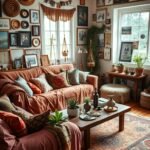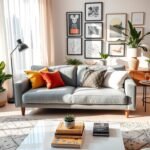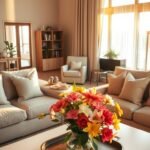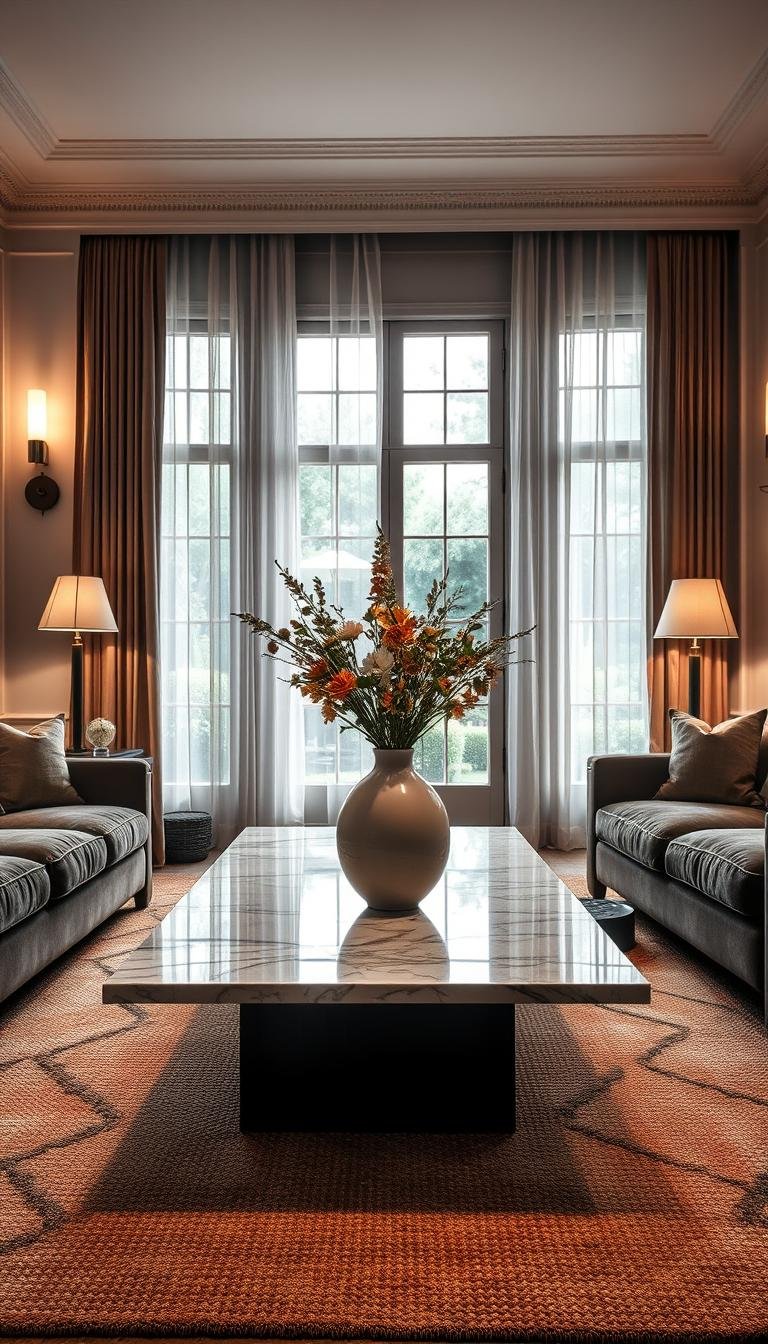
A classy interior can feel luxurious because its colors, materials, and furniture work together, not because every piece is expensive. If your living room feels unfinished or no longer fits your routines, a few thoughtful changes can make home feel more welcoming. The best luxury living room designs classy enough to last rely on proportion, tactile contrast, deliberate lighting, and choices that reflect the people who live there.
You can apply these ideas during a full redesign or a small refresh. A new arrangement, a richer mix of textures, or a personal artwork can shift the room’s feel without replacing everything. Your style can lean modern, traditional, or somewhere between; the goal is a space that looks considered and works for daily life.
Start by choosing one feature you want the rest of the room to support.
Begin With Proportion, Materials, and Architectural Detail
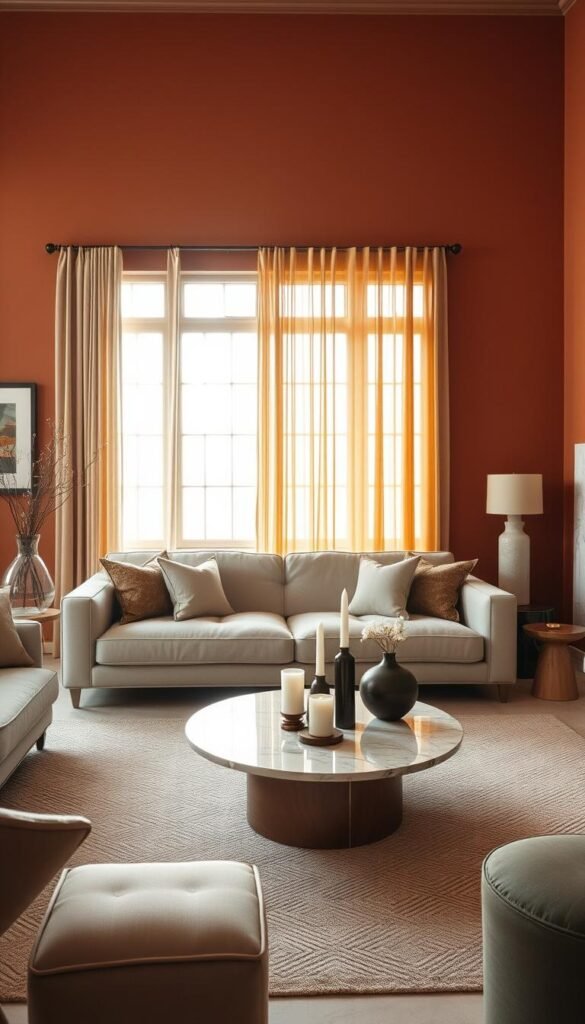
A room often feels more refined when its largest features have clear proportions and space around them. Good scale helps walls, ceilings, and furniture read as a whole, rather than as competing pieces.
Choose details that suit the home’s architecture, then let the strongest feature lead. Crown molding, wainscoting, and coffered ceilings can add structure when they belong to the house. If you are drawn to a more minimal interior, a single expressive wall finish or fireplace may be enough.
Give architectural features room to breathe
Architectural details work best when furnishings do not crowd them. Leave enough visual space around a fireplace, a paneled wall, or a coffered ceiling for its lines to remain clear. A room with simple walls can still feel polished through careful furniture scale and well-chosen materials.
Laura Jenkins designed a 1920s living room around a pink sofa and a rustic coffee table. Their contrast gives the room character without requiring every surface to make a statement. For another kind of warmth, Cleo Murnane used Roman clay walls with an Italian viola fireplace in a warm, minimal interior.
Let one architectural detail or material take the lead, and keep nearby finishes quiet enough to give it room.
Balance smooth finishes with tactile materials
Smooth stone or glass can feel more inviting beside warm wood, leather, velvet, or bouclé. A pared-back room needs this kind of texture to avoid feeling stark. Varying the feel of surfaces adds depth without adding extra objects.
Calacatta gold marble, travertine, and Nero Marquina are all stone options, but none is required for an elevated result. Wood grain, a textured fabric, or a well-made painted surface can bring similar visual interest at a more practical cost. For more approaches to contemporary luxury interiors, consider how craftsmanship and restraint work together.
Let one material or architectural feature lead, then use quieter finishes to give it breathing room.
Luxury Living Room Designs Classy Enough to Last
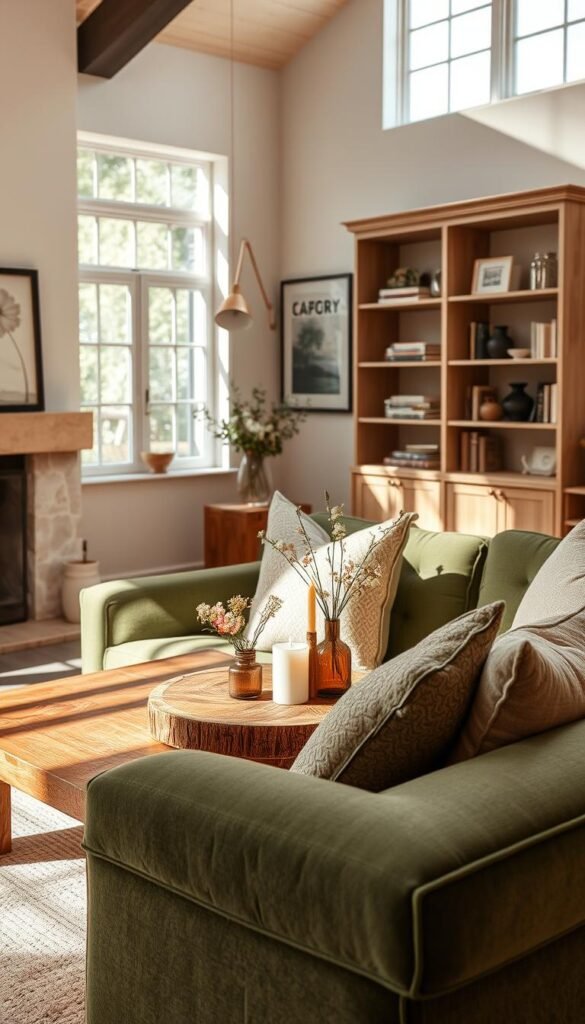
A lasting palette usually starts with a few compatible base colors and one intentional accent. A calm foundation makes a living room easier to update as art, textiles, or your taste changes.
Modern luxury living room designs classy enough for daily use balance sculptural furniture with calm color and tactile materials. Taupe, greige, ivory, warm beige, and soft charcoal can form a flexible base. Add brass or muted bronze sparingly, so the metal catches the eye without taking over.
Build a calm base with a considered palette
Color on walls has a different effect from color carried by upholstery, art, and textiles. A full wall color shapes the room’s overall mood, while a colored sofa or patterned cushion gives you a smaller, easier-to-change commitment. Consider how natural light shifts through the day and how the room’s colors connect to adjacent spaces.
Benjamin Moore’s 2026 Color Trends palette includes a range of grounded shades. Six useful starting points are Silhouette AF-655, Swiss Coffee OC-45, Raindance 1572, Narragansett Green HC-157, Batik AF-610, and Southwest Pottery 048. Silhouette AF-655, a blend of burnt umber and charcoal, is the brand’s 2026 Color of the Year.
Recent sofa choices also show that neutral does not have to mean gray. In King Living’s 2026 data, close to half of fabric sofa sales were neutral colors. Gray fabric sofas made up 10% of sales, down from 52% in 2019, while green rose from 1% to 18%. Brown accounted for 53% of leather sofa sales, compared with 24% for neutral colors and 11% for gray.
Use color where you want the eye to land
Choose a wall color when you want the room itself to carry the mood. Use upholstery, art, and textiles when you want color to feel more flexible. A colorful sofa can anchor a simple room, while a neutral sofa lets a strong artwork or patterned fabric take the lead.
An ELLE Decor Chicago apartment offers a confident alternative to a subdued base. Jewel-toned seating sits with Urban Electric Co. pendants and de Gournay wallcovering. The combination is vivid but intentional, not a requirement for every home. Explore modern classic living room ideas if you prefer a quieter mix of traditional details and current pieces.
Check paint and fabric samples in the room’s natural and evening light before committing.
Arrange Seating for Conversation and Everyday Use
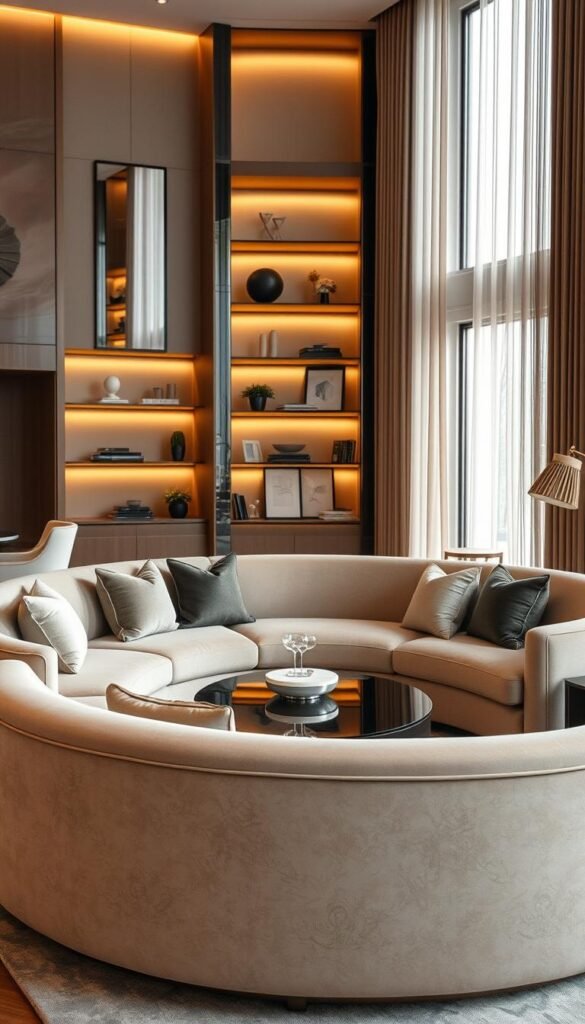
A comfortable seating plan makes it easy to talk, move around, and use the room without shifting furniture each time. The conversation area is the part of a room arranged for people to sit together and talk.
Keep the conversation area open to the room’s main walking routes. Facing seats help people speak comfortably, while a curved sofa can soften the arrangement and turn seats toward one another. The best setup leaves a clear path through the space.
Keep the conversation area easy to move through
In a small room, scale seating to the available floor area instead of forcing in a large sofa. A compact sofa with one chair may leave more usable space than a deep sectional. In a larger room, more than one seating group can help the space feel purposeful rather than empty.
A curved Vladimir Kagan sofa in a California desert retreat shows how one sculptural shape can gather seats around a focal point. In a Hamptons home, facing sofas sit beside an Azura marble fireplace wall, creating a more formal arrangement. Both layouts help people see one another without blocking the room’s natural flow.
For more examples of living room layouts that flow, focus on how seats relate to the focal point and the paths people use most.
Make one room serve more than one purpose
A great room can hold dining and lounging areas without a solid divider. In the 2026 House Beautiful Whole Home, the dining area sat at the far end of a great room, with stools tucked beneath the table when not in use. That keeps extra seating available without leaving it in the main path.
In a writing room, designer Mark Kennamer chose a Lee Industries sectional banquette instead of an overstuffed sofa to save floor space. A double-sided settee can provide party seating from both sides, while a sleeper sofa makes room for overnight guests. Match each piece to a real activity, rather than asking one seat to do everything.
Before buying a large piece, mark its footprint on the floor and test the main walking paths.
Choose a Sofa That Fits Your Room and Priorities
The right sofa is the one that fits the room’s circulation and gives you the comfort and finish you value most. Fit comes first, so check the dimensions, doorways, seat depth, upholstery, and intended layout before judging appearance alone.
A loveseat can suit a compact room, while a longer sofa can anchor a larger seating zone. Curved or sculptural shapes add interest without requiring more decorative clutter. Consider how you sit, how many people use the piece, and whether the fabric works with your household.
In 2026, typical U.S. sofa price tiers range from $300-$800 for budget models and $800-$2,000 for mid-range models. Upper-mid-range models generally cost $2,000-$3,000, while premium or luxury models range from $3,000-$10,000 or more. One current example, the Lulu & Georgia Cleary Sofa listed at $5,148, comes in 76-, 86-, and 96-inch widths.
| Product | 2026 listed price | Width | Depth | Height |
|---|---|---|---|---|
| Lulu & Georgia Cleary Sofa | $5,148 | 76/86/96 inches | 40 inches | 30 inches |
| Joybird Sebastian Sofa | $3,996 | 92.5 inches | 41 inches | 32.5 inches |
| Article Sanders Velvet Sofa | $1,099 | 85.5 inches | 38.5 inches | 32.5 inches |
| West Elm Bogart Loveseat | $899 | 60 inches | 32 inches | 25.2 inches |
The Cleary offers 23 fabric and color options. The Sanders comes in Pacific brown velvet, Pacific green velvet, Hestia ginger, Hestia gray, Ivory wool, and Sandstone wool. The Bogart has 77 color and material options, which can help you match a compact piece to an existing interior.
Numbers on a product page do not tell you how a sofa feels after an hour of reading or a full evening with friends. Compare seat depth and back support in person when you can. For a center table, size and clearance matter too; see how to choose a center table that works with your seating.
Measure the sofa’s full route into the room as well as the spot where it will sit.
Set a Realistic Budget for Design and Furniture

In 2026, traditional one-room design fees can reach $5,000-$20,000 or more before furniture, while an online Havenly plan costs $159-$499 per room. Those fees cover different scopes, so compare what each service includes before setting your total budget.
Separate design fees from the full cost of design plus furnishings. Traditional interior designers typically charge $150-$300 per hour. Their one-room fee may total $5,000-$20,000 or more before you buy furniture.
Havenly’s flat-fee online design plan includes a 3D rendering, a shopping list, and revisions. Its typical all-in cost for a room, including the design fee and furniture, is $2,500-$7,000 in 2026. A traditional designer’s typical all-in room cost, including fees and furniture, is $10,000-$30,000 or more.
Those all-in ranges do not describe identical service or the same furniture choices. A traditional designer may provide a different level of involvement than an online plan. The room’s size, your furniture selections, the project scope, and the pieces you already own all affect your household’s total.
A useful budget starts with the work you need done, not just the service name. Decide whether you need a complete layout, help choosing a few pieces, or a visual plan you can carry out yourself. Then check whether the proposed service covers shopping, delivery, and revisions.
List the furnishings you plan to keep and the ones you intend to replace. That can show where you have room to spend and where a smaller change may work. Before you agree to a service, identify which purchases and revisions its fee includes.
Set a separate limit for design services and furnishings so one part of the project does not quietly consume the other’s budget.
Size and Place the Rug to Anchor the Seating
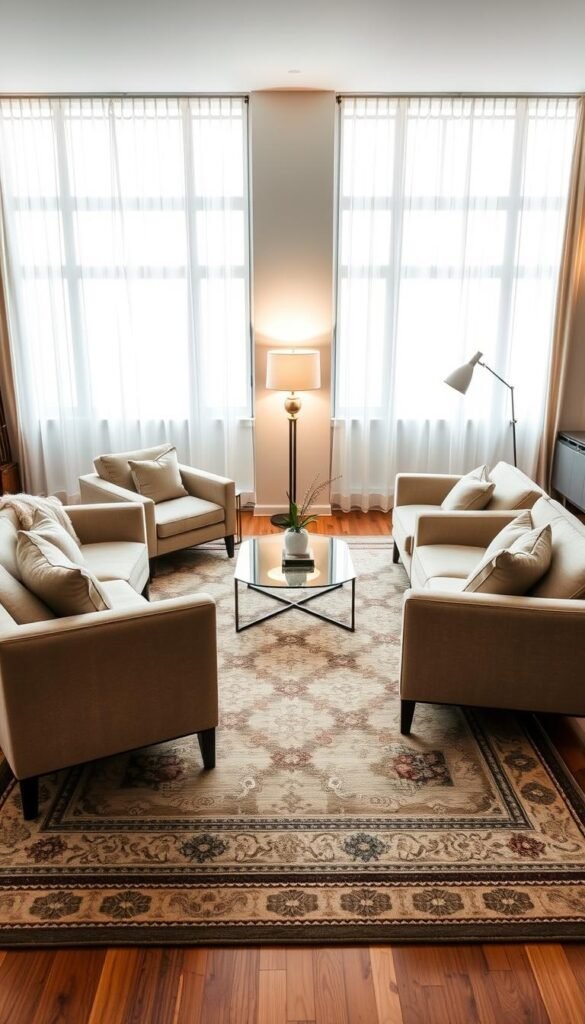
A rug anchors the seating best when it is large enough to connect the furniture while leaving a deliberate border of floor. Think about the whole group, not only the sofa: the chairs and their placement affect the size that feels balanced.
At minimum, place the front legs of every sofa and chair on the rug. That front-legs-on-rug layout visually connects the seating while keeping the rug from dominating the entire floor.
| Layout | Rug size guidance | Furniture placement | Bare-floor guidance |
|---|---|---|---|
| Medium room with front legs on rug | 8-by-10 feet | Front legs of sofas and chairs on the rug | Leave 8-18 inches |
| Standard room with all furniture on rug | 9-by-12 feet | Place all main furniture on rug | Leave 8-18 inches |
| Sectional with all legs on rug | 10-by-14 feet or larger | Fit every sectional leg on rug | Leave 8-18 inches |
These recommendations use different units and layouts, so measure your room and sofa before applying one. Atlanta Designer Rugs recommends leaving 8 to 18 inches of bare floor around a living-room rug. Its guidance also puts at least the front legs of all sofas and chairs on the rug.
King Living recommends extending a rug 20-30 centimeters beyond the sofa on each side and leaving 40 centimeters of floor between the rug and the wall. Its standard rug size is 200 x 300 centimeters, with 260 x 360 and 300 x 430 centimeters also available. Select designs can be custom sized.
For two-seater sofas, King Living recommends a 200 x 300-centimeter rug. For three-seater sofas and modular seating, its recommendation is 260 x 360 centimeters. A sectional with only its front legs on the rug needs at least an 8-by-10-foot rug, while 9-by-12 feet works better. Fitting every sectional leg calls for 10-by-14 feet or larger.
These dimensions can feel confusing because room layouts differ. A rug should relate to the sofa and the chairs, not float by itself between them. Leave enough floor visible to frame the seating group without cutting the chairs off from the sofa.
Measure the sofa, chairs, and open floor around them before ordering a rug.
Layer Lighting for a Softer, More Useful Room
A mix of daylight and several kinds of artificial light makes a room easier to use from morning through evening. More than one light source lets you read, talk, and unwind without relying on a single bright ceiling fixture.
Combine overall illumination with light aimed at specific tasks. Ceiling fixtures provide broad light, while sconces, table lamps, and floor lamps add softer pools and focused beams.
Make the most of daylight
Window treatments can preserve daylight while still offering privacy. Sheer curtains soften incoming light without blocking it completely. If a room faces a close neighbor, consider adjustable shades that give you more privacy when needed.
Ceiling fixtures and sconces can support daylight when clouds roll in or evening arrives. A sculptural chandelier or brass lamp can make a statement, but the room should not depend on one overhead light alone. A mix of sources gives you more control over how the space feels.
Combine ambient and task lighting
Place reading light near the seat where you usually read. A table lamp beside a standard sofa that is 17-20 inches high generally has a total height of 24-30 inches. Beside a sofa at least 21 inches high, a general total lamp-height range is 28-34 inches. Floor lamps for ambient living-room light are generally 58-64 inches tall.
Use these checks to spot gaps in the lighting plan:
- Identify the room’s darkest area.
- Place reading light near the seat.
- Use a central fixture for overall illumination.
- Aim adjustable light at art or architectural details.
- Use dimmers where available.
For a more complete approach to modern luxury living room interiors, consider how daylight, fixtures, and reflective surfaces work together. A mirror can help bounce light into a dimmer corner without adding another lamp.
Sit in the main seating spot after dark and check whether the light reaches the tasks you actually do.
Finish With Art and Personal Details
A personal object or artwork gives a carefully designed room a point of view that cannot be bought as a matching set. One memorable piece can anchor a wall, while smaller objects support it without fighting for attention.
Give your strongest artwork or sculpture enough room to register. A New York loft featured in ELLE Decor uses spherical artwork by Jose Dávila as a focal point. The distinct shape draws the eye without needing a wall full of competing objects.
Choose artwork that has room to stand out
Let the wall and nearby furniture help frame a distinctive piece. Smaller objects can sit on a shelf or table nearby, but they do not all need equal attention. A sculptural cocktail table can add character through shape and material; a distinctive center table can serve as a useful focal point as well as a practical surface.
A vintage Mario Bellini sofa in an ELLE Decor Venice home pairs with a sculptural cocktail table. The mix shows how a recognizable vintage piece can feel at home beside a newer form. For more modern luxury wall decor ideas, think about how art, mirrors, and personal collections can shape a wall.
Mix collected pieces without making the room feel staged
The ELLE Decor Chicago apartment pairs jewel-toned seating with Urban Electric Co. pendants and de Gournay wallcovering. Each element has presence, but they share the room rather than forming a matching set. A mix of strong choices feels personal when you leave space for each to be seen.
Try these finishing moves as you bring the room together:
- Display one meaningful object.
- Mix old and new.
- Vary materials and patterns.
- Avoid matching every accessory to the upholstery.
Restraint means giving memorable pieces room to be seen, not removing every sign of personality.
Keep the objects you enjoy looking at, and remove the ones that feel like they are only filling a gap. Edit the final arrangement until each favorite piece has space to register.
Make One Thoughtful Change at a Time
A polished home takes shape through choices that make daily life feel better as well as look considered. The most elegant result is the one that suits your room and the people who use it, not a style copied exactly from somewhere else.
Choose one priority, such as replacing a worn rug, improving a dark corner, or rearranging the seating. Live with that change long enough to see how it affects the room before adding another. Small steps can give you a clearer sense of what works than a rushed overhaul.
Pick one change you can complete this month, measure the space it affects, and decide what success will look like before you shop.