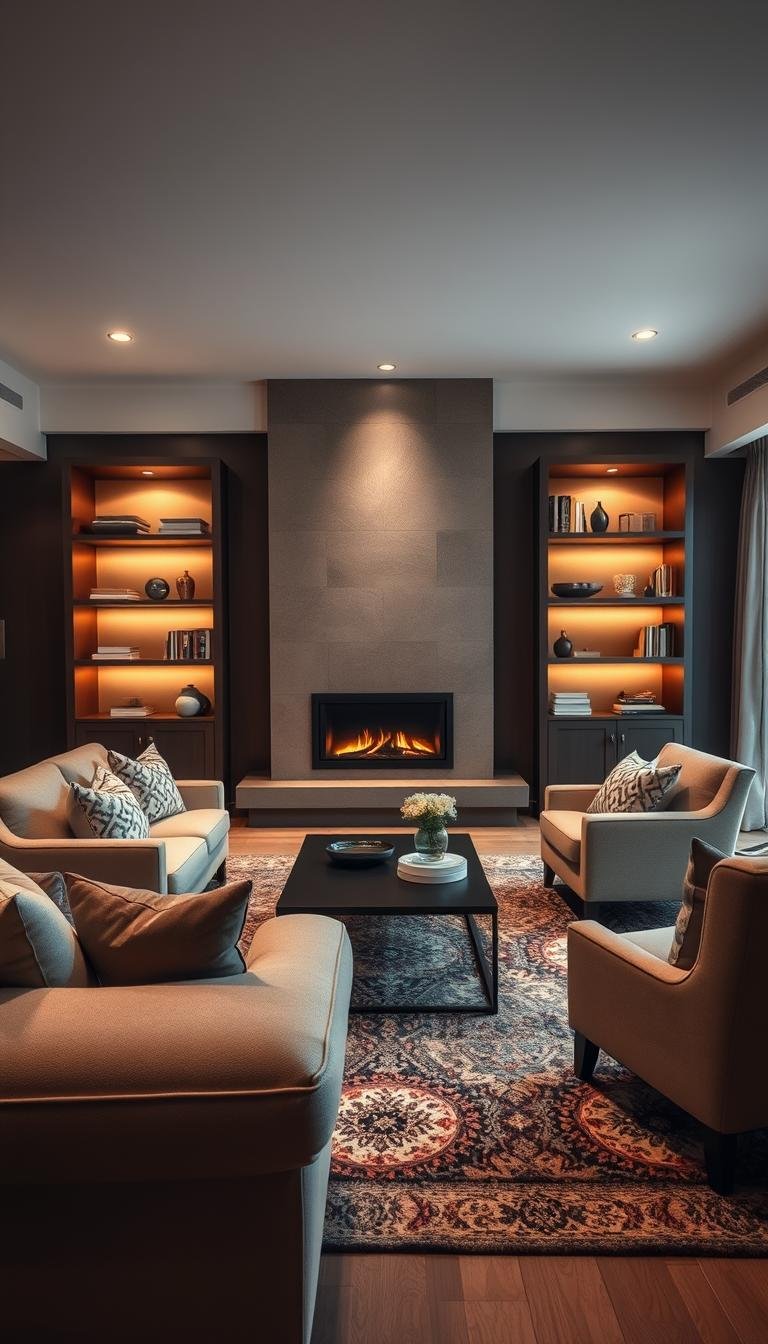
A fireplace can make a living space feel inviting before you even light a fire. If you are starting with an empty room or refreshing a familiar one, thoughtful choices can make your home feel comfortable and personal. Living room designs with fireplace work best when they reflect how you relax, host, and move through the space.
You can shape that feeling with a useful floor plan, finishes that suit your interior, and details that feel like you. The right ideas can help you make the fireplace part of daily life, rather than a feature that only looks good in a photo.
The most successful design is the one that fits your home and the way you use it.
Living Room Designs With Fireplace Start With the Floor Plan
Sketch the main walking route before you decide where the sofa goes. A useful plan begins with doors, windows, and entry points, then shows where people naturally pass through the room. Movement comes first, because a lovely seating group is frustrating if you have to squeeze past it every day.
Mark the fireplace and the other fixed features on your sketch. Then test the furniture against five practical checks before settling on a layout.
- Main walking route: leave about 30-36 inches for a primary walkway when the room allows.
- Doorway clearance: keep doors and entry points easy to use without shifting a chair.
- Window access: preserve a comfortable route to windows and avoid blocking their operation.
- Seating view: check that each seat has a useful view of the fireplace and conversation.
- Furniture scale: compare each piece with the room, not just with the floor plan.
Choose the fireplace’s role before arranging furniture, then protect the route people use to cross the room.
Start with the room’s circulation
Once the route is clear, place the largest furniture pieces around it. The main sofa often works best with its back toward an open walkway, rather than across a doorway. Allow enough room to pass behind a chair, and avoid wedging small tables into the path between the entry and the rest of the living room.
Kelsey Fischer’s layout guidance emphasizes choosing the fireplace’s role before arranging furniture. That decision helps you judge which seats need a direct view and which can face inward. For more ideas on scaled furniture and clear movement paths, look at how each activity fits within the same space.
Choose a seating shape that supports conversation
U-shaped seating encourages conversation because people can see one another without turning away from the fire. Paired chairs across from a sofa create a similar balance, while a sofa with one or two chairs leaves the arrangement more flexible. An expert living-room seating rule also favors seats angled toward each other or arranged in a U.
Try the furniture in place with a simple floor sketch or temporary markers. A coffee table should be reachable from the main seats, but it should not split the group into separate islands. Sit in each planned seat and check that the fire is visible without blocking a doorway.
Decide Whether the Fireplace Leads or Blends In
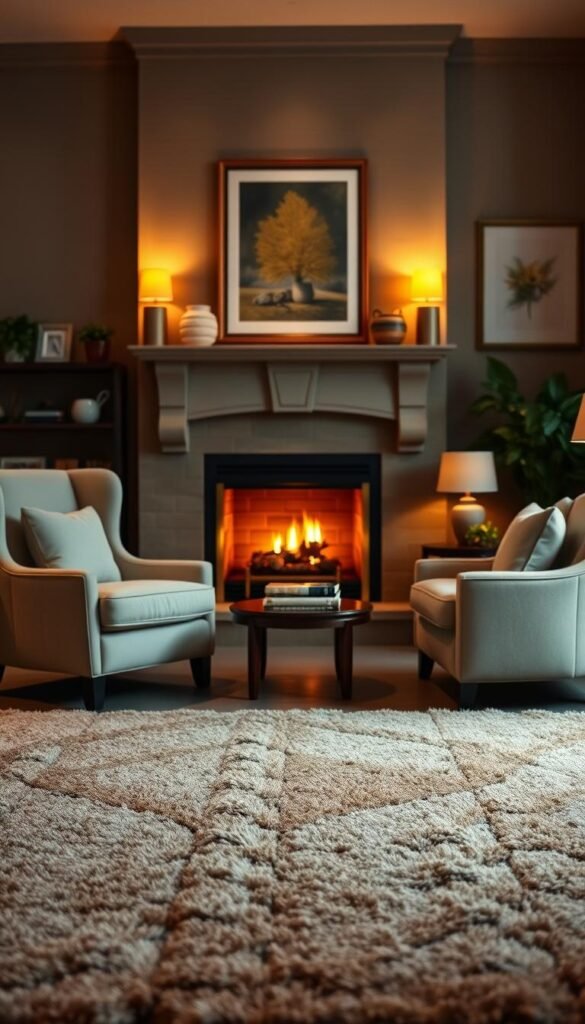
A fireplace can lead the room, support its style, or quietly fade into the background. Decide which role suits the scale of your living space before choosing finishes or furniture. A clear visual hierarchy helps the fireplace feel intentional, whether it becomes the focal point or stays a quieter feature.
A focal-point fireplace draws the eye with contrast, shape, or a strong surround. Furniture can face it directly, and a single prominent piece of art may reinforce its place. A decorative feature has a supporting role: it adds character, but other elements share attention.
A blended-in fireplace works when you want a calm wall rather than a dramatic center. Similar colors across the fireplace and wall can soften the contrast. A dark painted fireplace can recede against a similarly dark wall, making the firebox feel less dominant without removing its architectural detail.
| Fireplace role | Furniture cue | Visual effect |
|---|---|---|
| Focal point | Seats face the fireplace | Strong center of attention |
| Decorative feature | Seats share attention | Fireplace adds character |
| Blended-in backdrop | Seats face another feature | Quiet, low-contrast wall |
Scale matters as much as color. Swati Goorha warns that a fireplace that is too small can look lost in a large room. A broad wall may need a larger surround or balanced nearby features, while a modest fireplace can feel right when the rest of the room stays visually light.
An off-center fireplace does not have to become the room’s central feature. A coffee table can frame the seating area and create a visual center of its own. You can also choose furniture with clean lines so the fireplace remains part of the composition instead of competing with every object.
For another approach to grouping furniture around the hearth, consider these conversation-friendly living room layouts. Choose the role that matches the room’s scale, not just the look of one inspiration photo.
Small Living Rooms Need a Compact, Clear Seating Plan
In a compact room, a pair of chairs or a small sectional can make the fireplace feel like a natural anchor. Keep the pieces visually light and leave enough room to use the hearth comfortably. Flexible seating helps a small living room feel welcoming without making the floor plan feel packed.
A compact sofa with two chairs gives you separate places to sit while keeping the group easy to rearrange. A small sectional can work when it follows the room’s shape instead of cutting across a doorway. Two armchairs can also flank a decorative fireplace, leaving more open floor around the center.
Keep the seating close and flexible
Keep the coffee table within reach, but leave enough space to sit down and stand up comfortably. A typical coffee-table-to-sofa gap is about 16-18 inches. A round table can make it easier to move between seats because it has no sharp corners, while swivel chairs can turn toward the fire or the TV.
A small living room with a fireplace and TV layout can angle seating so both features remain visible. When the arrangement allows, place the TV on a separate wall rather than forcing it above the firebox. That can keep the room more comfortable to use, especially when people want to watch television without facing the fireplace directly.
- Choose compact seating with slim arms or a smaller footprint.
- Use swivel chairs to turn between the fireplace and TV.
- Favor a round coffee table for easier movement around its edges.
- Use vertical shelving to store books without taking much floor space.
Make a corner fireplace feel intentional
A corner fireplace can free up central wall and floor space, which may suit a narrow room or an unusual floor plan. Set the seating so the fireplace feels connected to the group, rather than treating it like an awkward extra at the edge. A small rug can help give the seating area a clear shape.
The tradeoff is that a corner fireplace can make furniture placement awkward if the seating cannot face it comfortably. A chair turned slightly toward the fire may solve the problem, but do not twist every seat just to force a view. Keep the furniture useful for conversation and leave a clear path around the coffee table so the seating area remains easy to use.
How to Balance a TV and Fireplace
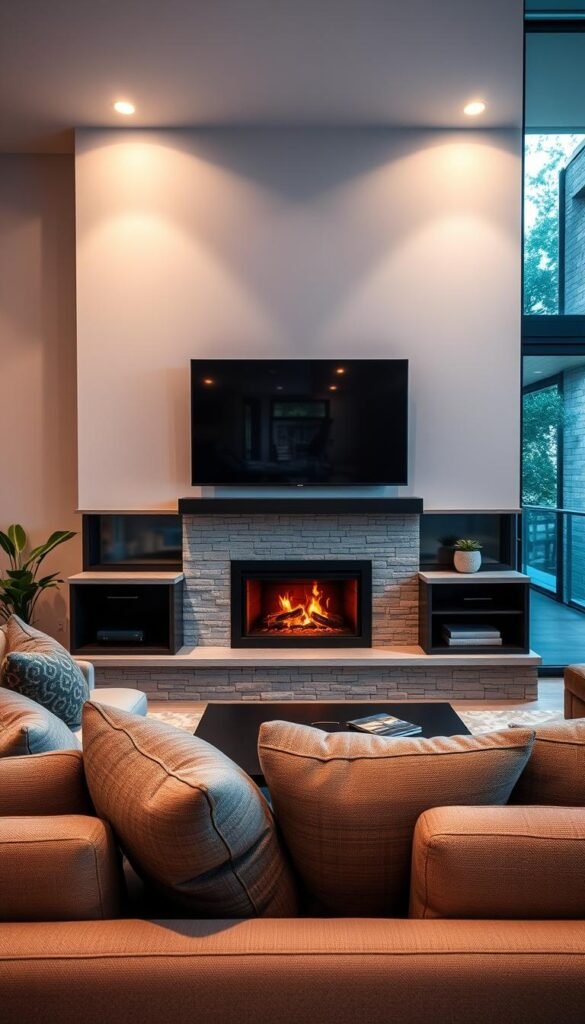
A TV above a fireplace can save wall space, but only if the model’s heat-clearance instructions allow it. The safest placement depends on the fireplace and the screen’s position, so do not guess at a gap. A streamlined wall can look clean, but the installation still has to follow the fireplace manual.
Living room designs with a fireplace and TV usually use one of three arrangements: above the fireplace, side by side on the same wall, or on a separate wall. Each option changes the room’s balance and viewing angles. The right choice also depends on where the seats face and how you want the wall to read.
| TV position | Layout effect | Heat-safety check |
|---|---|---|
| Above fireplace | One combined wall feature | Follow the model’s safe distance |
| Beside fireplace | Shared wall at different heights | Check nearby heat exposure |
| Separate wall | Fireplace and screen have distinct roles | Follow the TV location guidance |
Modern fireplace ideas with a TV above often use a simple wall finish and concealed cables. That look works only when the fireplace model allows the required clearance. Safe distance depends on the fireplace model, mantel, heat-management system, wall material, and TV position.
A mantel or heat shield does not replace the fireplace manufacturer’s instructions. A shield may be part of a tested setup, but it cannot make an unapproved TV location safe by itself. Check the viewing angle too: a screen mounted too high can be uncomfortable during a long movie.
For more ways to integrate a screen with built-ins or a fireplace wall, explore these TV wall design options. Check the fireplace manual before fixing the TV height or routing its cables.
2026 Fireplace Trends Bring Color and Texture
A current fireplace can feel fresh through color and texture, not just a dramatic shape. Saturated greens, oxblood, plum, ochre, and tobacco bring depth to the room when you use them with care. One strong choice can make the wall feel current without turning every surface into a statement.
Linear fireplaces set into plaster or stone give a contemporary wall a clean shape. Low-profile hearths keep the firebox visually close to the floor, while warm wood can soften the harder edges around it. Tonal stone adds interest through natural variation, rather than a sharp contrast in color.
Arched openings offer a softer outline than a sharp rectangular firebox. A curved hearth bench can echo that shape and add a place to sit or pause. Natural finishes keep the effect grounded, especially when the surrounding room has simple furniture and a limited palette.
Textured walls can change the way light moves across a fireplace design. Limewash gives a soft, uneven finish, while Venetian plaster creates a smoother surface with subtle depth. Fluted panels and textured stone add a more defined pattern, so you can choose the level of detail that fits the rest of the interior.
A bold surround can work with restrained furniture and a limited palette. For example, a deep color on the fireplace wall can become the room’s main design move, while neutral upholstery gives it breathing room. If your existing space already has patterned rugs or busy artwork, a quieter finish may feel more balanced.
These ideas are directions, not a checklist. You can take the curved form without adding a saturated color, or choose textured stone without changing the hearth shape. Choose one trend to lead the room and let the remaining finishes support it.
Choose a Surround Material That Fits the Room
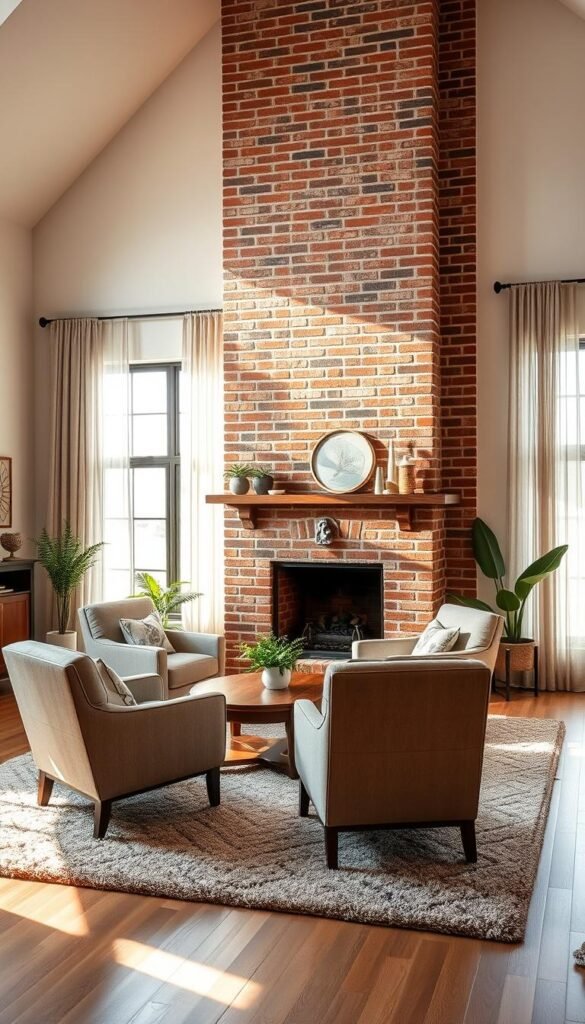
The surround can be the room’s quiet frame or its most distinctive surface. Choose a finish that relates to nearby materials and the scale of the wall. Balance is the goal: a small space can feel crowded when the fireplace and every surrounding surface compete for attention.
Brick gives a familiar architectural texture and can make a new fireplace feel connected to an older home. It works as an exposed feature or as a painted surface when you want the pattern but less color contrast. The chimney decoration ideas you choose can also carry the material upward, making the wall feel taller.
Stone, marble, and brick make the surround a feature
Marble can have dramatic, fluid movement, so a single slab may become the main visual event. Stone creates a substantial wall, with a look that can range from finely finished to strongly textured. The exact pattern matters: a highly veined marble draws more attention than a calm, even surface.
Brick usually reads as more familiar and patterned than a large stone slab. It can add warmth to a simple interior, but a strong brick color may compete with other bold finishes. Keep the fireplace’s scale in view, especially when the room already has prominent wall treatments or large artwork.
Plaster, tile, and wood create a different kind of texture
Plaster can create a smooth, sculptural surface around the firebox. Plastered European-style surrounds bring texture without a visible grid or strong pattern. Tile offers more options for color and layout, while metal adds a crisp edge that can suit a pared-back interior.
Wood can add a softer, more familiar look, but the fireplace’s installation instructions determine where combustible finishes can go. Avoid choosing it by appearance alone. Metal, tile, plaster, stone, brick, marble, and wood can each change the balance between the surround and the rest of the walls.
An expressive marble slab or textured wall can overwhelm a small room if the other surfaces compete. In a compact space, let one finish carry most of the detail and keep nearby materials quieter. Bring samples into the room and compare them in both daylight and evening light.
Mantel Decor That Looks Collected, Not Crowded
A few well-chosen objects usually make a mantel feel more personal than a crowded row of accessories. Start with one larger piece, then add a small number of objects at varied heights. Space between pieces lets the architecture show through and keeps everyday fireplace decorating ideas easy to live with.
Try one of these simple groupings, using objects you already enjoy rather than buying a matching set.
- Framed art with a vase beside it.
- A mirror with taper candles placed at different heights.
- A sculptural object with a low stack of books.
- A small collection of ceramics grouped together.
Modern fireplace decor ideas often look strongest with a limited palette and a mix of heights. Brass can add a warm accent, but it does not need to appear in every object. Rayman Boozer recommends limiting materials and letting them tell the design story, so choose a few finishes that already feel connected.
For a more personal arrangement, combine framed art and a mirror in different sizes or display a single oversized piece. A low stack of books can anchor a small object, while a vase adds a different silhouette. Keep the objects useful or meaningful, rather than filling the mantel just because there is room.
If an old mantel feels dated, paint it the wall color to make the whole surface feel calmer. Gesso can give an existing mantel a plaster-like finish, changing its look without replacing it. Before using either treatment, make sure the finish suits the mantel’s material and the fireplace’s installation requirements.
A basket of logs can make a gas, electric, or unused hearth feel inviting. Set it where it looks intentional and does not interfere with using or servicing the fireplace. For more fireplace wall and mantel styling ideas, look for arrangements that leave the wall itself visible. Leave enough open surface for the mantel to read as part of the architecture.
Layer Lighting, Art, and Soft Textiles
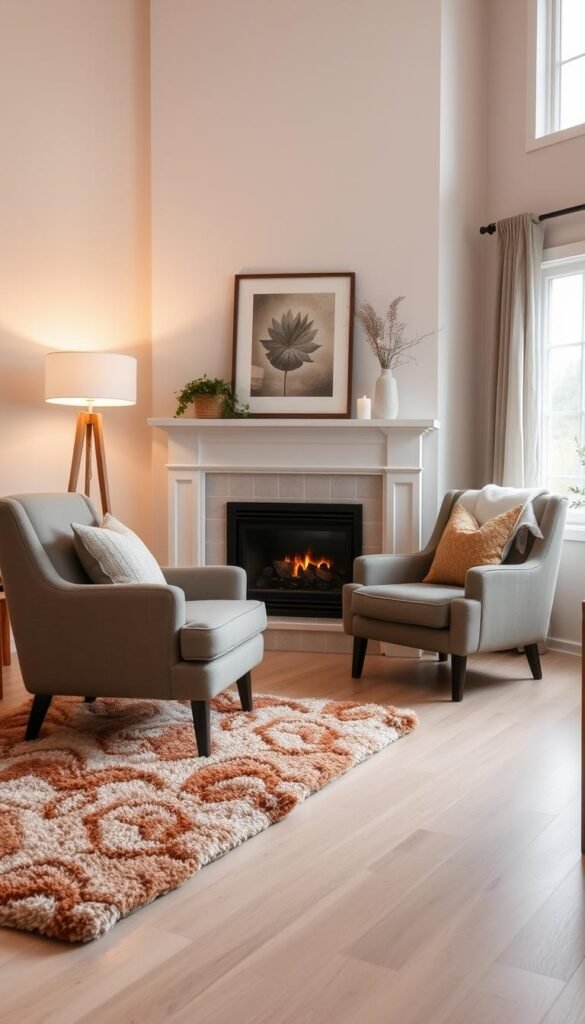
A fireplace does not have to make the room feel dim or overly formal. Combine overhead, task, and accent light so the living room feels comfortable at different times of day. More than one light source lets you adjust the mood without relying on a single bright ceiling fixture.
Overhead light serves the whole room, while task light supports reading or other close work. Accent lighting can highlight architectural features, artwork, or a textured wall. A chandelier can give the ceiling a clear presence, especially when its shape relates to the furniture below.
Sconces can frame the fireplace wall, while a floor lamp can bring light close to a reading chair. Bright windows may make the room feel open during the day, but additional evening light keeps it from becoming a dark corner after sunset. Use a dimmer where available to make a fixture more adaptable.
A rug can anchor the fireplace seating and define the living area without adding another hard edge. Choose a size that connects the furniture rather than leaving a small island beneath the coffee table. Pillows and a throw add softness, and a restrained pattern or color can keep the fireplace as the strongest feature.
Artwork can help the room feel connected from one wall to another. A single large piece brings a clear shape, while several smaller works can build a more casual arrangement. Keep the art’s scale in proportion to the wall so it supports the room rather than appearing stranded above the furniture.
Lighting also changes how finishes look. A stone surface may read cool in bright daylight, then feel warmer under lamps at night. For additional overhead-light inspiration, see these chandelier styles and lighting ideas. Test the lighting from the seats where you actually read, talk, or relax.
Match Fireplace Type to Your Home and Heating Needs
The right fireplace type is the one that fits both your room and how you expect to use it. Wood-burning, gas, and electric fireplaces offer different experiences and placement choices. Start with your needs, then consider the visual style and the installation limits in your home.
A wood-burning fireplace brings the familiar experience of a real wood fire, along with the need to store fuel and manage ash. A gas fireplace can offer a more controlled flame, with designs that range from linear openings to traditional log styles. An electric fireplace can add a flame effect or supplemental heat without a wood-burning fire.
Wood-burning fireplaces suit a traditional hearth experience
Wood-burning units often suit homes where the hearth is part of the room’s character and the owner wants a wood fire. Your design also needs to account for the fireplace’s installation and venting needs. Some fireplaces work as room dividers: a double-sided unit can separate open-plan areas while allowing views through the firebox.
A freestanding or suspended fireplace can act as a sculptural feature instead of sitting within a conventional wall. Those forms need a suitable location and installation plan, so their shape alone cannot decide whether they fit. They can still create a striking center in a room with a relatively simple interior.
Gas and electric units suit different installation needs
A linear gas fireplace can suit a contemporary wall, while a traditional log set can fit a classic room. An electric insert can update an existing opening without requiring the same design approach as a new built-in unit. Electric models also come as wall-mounted and freestanding designs.
| Type | Room fit | Useful design option |
|---|---|---|
| Wood-burning | Traditional hearth setting | Classic firebox with visible logs |
| Gas | Contemporary or classic room | Linear unit or traditional log style |
| Electric | Flexible existing or new location | Insert, wall-mounted, or freestanding |
These choices are not interchangeable. A gas unit needs the right fuel connection and venting plan, while an electric unit needs a suitable power setup. Your preferred look can narrow the options, but the room’s existing conditions should shape the final decision.
Confirm the fuel connection and installation requirements before committing to a design.
Linear Electric Fireplaces: Models, Heat, and Circuit Needs
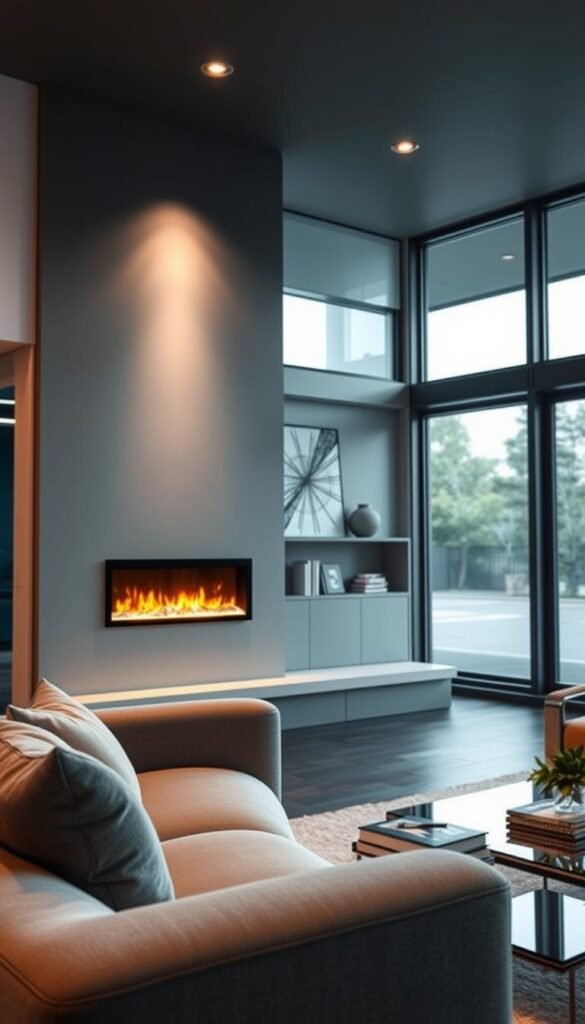
Linear electric fireplaces range from a decorative focal point to a supplemental heat source. Listed 2026 starting prices span $759 to $5,029 for these five models. Price and function vary, so compare the specified feature as well as the appearance before choosing a unit.
The Napoleon Entice starts at $759, while the SimpliFire Allusion Platinum starts at $1,499. The Dimplex Ignite XL starts at $3,049, the Modern Flames Orion Slim at $4,479, and the Napoleon Luminex at $5,029.
| Model | Listed starting price | Specified feature |
|---|---|---|
| Napoleon Entice | $759 | Linear electric design |
| SimpliFire Allusion Platinum | $1,499 | Linear electric design |
| Dimplex Ignite XL | $3,049 | 5-year parts-and-labor warranty |
| Modern Flames Orion Slim | $4,479 | LCD virtual-flame technology |
| Napoleon Luminex | $5,029 | LCD virtual-flame technology |
The Dimplex Ignite XL, Ignite XL Bold, Ignite Evolve, and Ignite Ultra have a 5-year parts-and-labor warranty. The Orion Slim and Luminex use LCD virtual-flame technology. These model details can help you compare what is included beyond a long, linear shape.
A 120V model provides 5,000 BTUs and supplemental heat for up to 400-500 square feet. Dual-voltage models provide 5,000 or 10,000 BTUs, with up to 1,000 square feet of coverage at 240V. The 10,000-BTU output depends on using the 240V setting.
A 1500W electric fireplace heater on a 120V circuit should use a dedicated circuit to help prevent tripped breakers. The circuit and voltage affect how the heater works, so include them in the decision before settling on a model. Match the heater’s voltage and circuit needs to your room before choosing the unit.
What a Fireplace Upgrade Costs and How Long It Takes
A fireplace upgrade budget depends on the appliance and the work needed to connect and finish it. In 2026, a gas fireplace upgrade project is estimated at $7,000-$19,00+, with an average total of $8,600 for upgrading an existing fireplace with a gas fireplace or insert. Project totals vary from insert-only installation estimates.
A fully installed gas insert is estimated at $7,800-$9,800. A direct-vent fireplace is a sealed-combustion fireplace that draws air from outdoors and sends exhaust outdoors through a vent. A direct-vent prefab gas fireplace is estimated at $7,200-$16,200.
| Project | Estimated cost | Typical timing | Scope note |
|---|---|---|---|
| Gas fireplace upgrade | $7,000-$19,00+ | Under a day or two once planned | Average project total: $8,600 |
| Gas insert | $7,800-$9,800 | Less than one day for most installs | Fully installed estimate |
| Direct-vent prefab gas fireplace | $7,200-$16,200 | Under a day or two once planned | Prefab gas fireplace project |
| Gas insert with existing gas and electrical access | Average $8,000 | Less than one day for most installs | Access is already in place |
| Electric fireplace installation | $500-$3,000 | Varies by installation | Electric fireplace project |
Timing is not the same as planning time. A gas upgrade may take under a day or two once planned, and most gas insert installations take less than one day. A long gas-line run can raise the cost, while a project with existing access may avoid some added work.
Five details can change the scope and final price:
- Unit selection: appliance style and features affect the starting cost.
- Venting: the route and type of venting add work to the project.
- Gas-line distance: a longer run can increase installation costs.
- Electrical access: existing access and any needed changes affect the work.
- Finish work: the surround and nearby surfaces may need repair or replacement.
A gas insert is a factory-built fireplace unit fitted into an existing masonry fireplace. Keep its estimate separate from a full gas fireplace upgrade, since the project scopes can differ. Ask for an itemized scope that separates the appliance, installation, venting, and finish work.
Fireplace Clearances and TV Safety Rules
Fireplace clearance measurements depend on what kind of fireplace you have, so identify the unit before planning a mantel or hearth. Traditional masonry measurements are not universal rules for every factory-built appliance. The exact unit matters, and its installation manual and local code determine what applies.
Under the cited International Residential Code provision, a projecting combustible mantel must be at least 12 inches above a traditional masonry fireplace opening. Combustible trim may be as close as 6 inches if its projection is limited to 1/8 inch per inch above the opening.
Traditional masonry fireplace clearances
Combustible framing must be at least 2 inches from the sides and front of the masonry fireplace and 4 inches from the back. These dimensions describe the stated masonry conditions, not every appliance or installation. Do not transfer them to a factory-built unit without its manual confirming they apply.
For openings under 6 square feet, the hearth extension must reach at least 16 inches in front and 8 inches beyond each side. Openings of 6 square feet or more require at least 20 inches in front and 12 inches beyond each side.
Masonry hearth extensions are generally concrete or masonry at least 2 inches thick. The thickness may be reduced to 3/8 inch of approved noncombustible material if the firebox is raised at least 8 inches. The height condition and material approval both matter.
Factory-built units and mounted TVs follow different instructions
UL 127 factory-built fireplaces may allow reduced clearances when the manufacturer permits them. The test keeps the firebox exterior no more than 175°F above room temperature when internal temperature reaches 2030°F above room temperature. That test result does not set a universal clearance for every model.
A TV’s safe distance depends on the fireplace model, mantel, heat-management system, wall material, and TV position. The fireplace manual sets that distance. A TV location that works for one model may be unsuitable for another, even when the two units look similar.
Use the instructions for your exact appliance rather than applying masonry figures to a factory-built unit. Local rules can also add requirements to the manufacturer’s directions. Check the local code and the exact installation manual before building or mounting anything above the firebox.
What Fireplace Adds Most to Home Value?
A fireplace may appeal to buyers, but its presence alone cannot guarantee a higher sale price. A Hearth, Patio and Barbecue Association study gives a consumer estimate of approximately $2,750 in added home value from a hearth appliance. That figure is an estimate, not a promise for an individual property.
A 2016 Angi survey found that 70% of real estate agents considered fireplaces valuable. In that same survey, 77% of potential buyers said they would pay more for a home with a fireplace. These findings describe buyer and agent views from the survey, not a set amount added to every sale.
Buyer interest is not the same as a guaranteed increase in a specific home’s selling price. A fireplace can make a room feel more memorable, but its effect depends on the home and the buyer. A feature that feels useful to one person may not matter as much to another.
For your own decision, consider whether you will use the fireplace and whether its design suits the room. The value of a comfortable living space is not measured only at resale. Treat resale appeal as one factor alongside your own use of the room.
Design a Living Room Without a Fireplace
Without a fireplace, a strong visual anchor can still make the room feel complete. Choose one feature that gives the living room a clear center, then arrange the space around it. A room needs a purpose, not necessarily a hearth, to feel welcoming and finished.
Four focal-point options can give you a clear starting place:
- An art wall with one large piece or a considered group of works.
- A substantial bookcase that holds books, objects, and closed storage.
- A seating arrangement that faces a window view.
- A standout light fixture that draws attention overhead.
Once you choose the anchor, use a rug to define the seating zone. Layered lighting helps the room work at different times of day, while a focused group of chairs and a sofa gives the space a clear use. A reading corner, work spot, or conversation area can make the room feel planned rather than empty.
Give the room a clear reason to gather
Living room design without a fireplace can center on a view, a favorite piece of art, or a bookcase with character. The furniture does not need to point at a blank wall. It can frame the window or face inward so people can talk easily.
Some homeowners remove or downplay fireplaces because they need the floor space, prefer a different focal point, or want to avoid maintaining an unused feature. That choice depends on the home and how its occupants use the room. A fireplace can be meaningful, but it does not have to define every living space.
A standout light fixture can provide a sense of occasion without taking over the floor plan. A chandelier offers overhead light and a strong shape, while a floor lamp can make a smaller reading zone feel distinct. Choose one feature to organize the seating around, then use lighting and textiles to make the area feel inviting.
Turn Fireplace Inspiration Photos Into a Room Plan
Inspiration photos are most useful when you look for one design decision you can adapt. Save living room fireplace ideas on Pinterest to a mood board, then compare them with your actual room. Borrow one idea at a time, rather than trying to recreate a whole interior that may have different proportions.
Use a three-point photo audit to separate a good idea from a poor fit:
- Scale: compare the fireplace size with the wall around it.
- Materials: compare the surround finish with nearby materials.
- Room use: check the space needed for seating and circulation.
A fireplace that fills a tall, broad wall in a photo may feel oversized in a smaller room. The same surround can also look different beside your own flooring, paint, or woodwork. A saved image is a useful reference, but your room’s real dimensions should guide the decision.
Look at what you like in each example: color, texture, silhouette, or mantel styling. You may prefer the arched shape from one photo and the calm palette from another. Combining a few specific features can feel more personal than copying a finished room exactly.
Before you commit, look at the wall from the seats where you will spend time. Check whether the fireplace size feels balanced from that view and whether the chosen finish relates to other surfaces. For more ways to connect the wall with the room’s layout, review these living room layout ideas as a source of proportions and seating cues.
Use an inspiration photo to identify one detail you can adapt, then judge that detail against your room’s real scale.
A picture cannot show every practical constraint, including the space a finished seating plan needs. Before making a change, compare your preferred finish and proportions with the actual wall and seating area.
Choose the Feature Your Room Can Live With
The best fireplace plan is one that feels right in your room on an ordinary day. Good design starts with how you use the space, not with copying a look that belongs to someone else’s home. A well-chosen feature should support your routines as much as your preferred style.
Make one useful move before choosing finishes or an appliance: measure the wall and main seating area, then sketch a workable arrangement. That quick plan gives you a real scale to consider and helps your next design choice fit the room. Measure your wall and seating area, sketch one workable layout, and use it to guide your next design choice.